
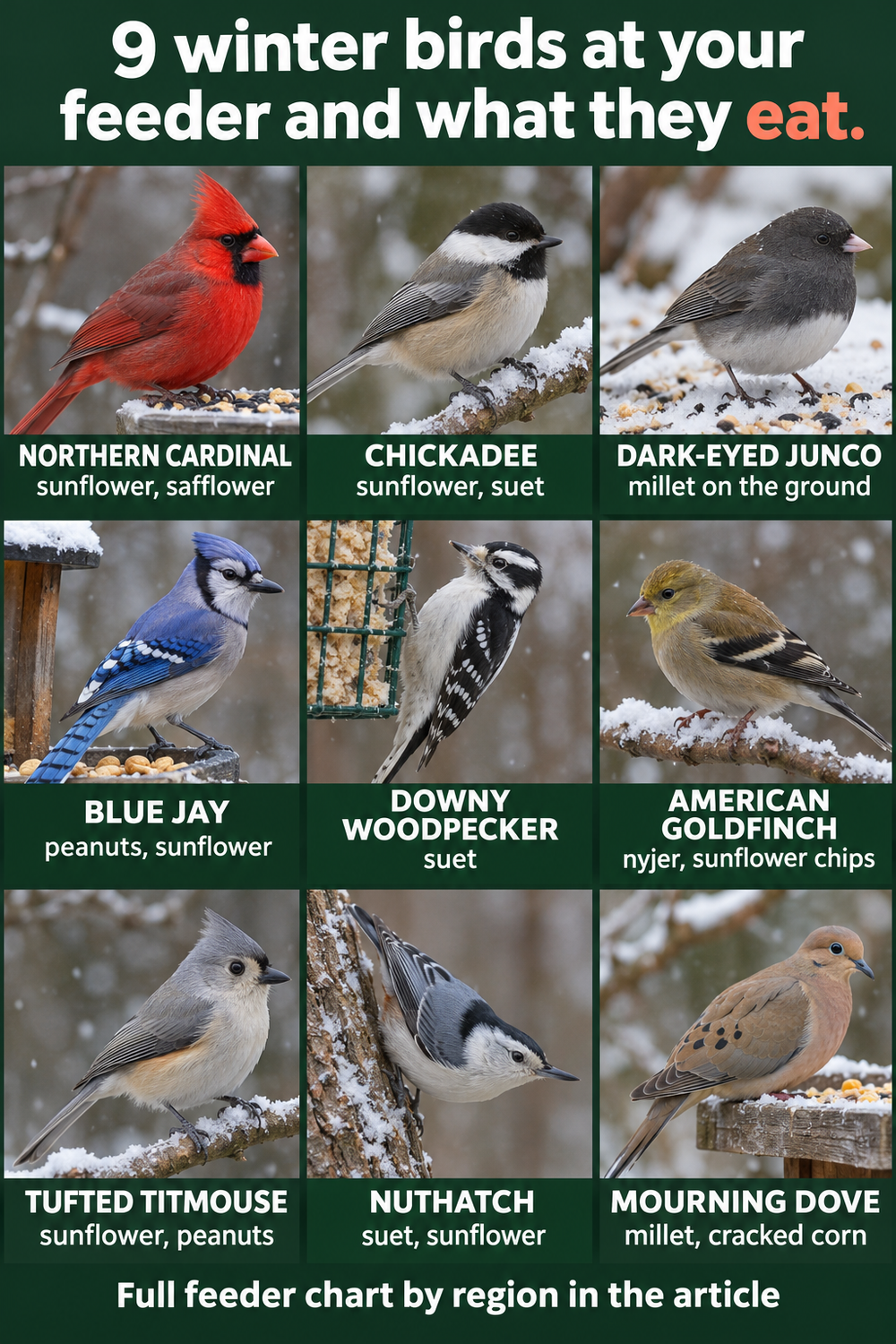
These are the winter birds at feeder stations you’re most likely to see across most of the US. Below is how to recognize each one, what it eats, which feeder it prefers, and a quick chart to print and keep by the window.
Quick answer
Quick answer: The 9 most common winter feeder birds are the Northern Cardinal, chickadees, Dark-eyed Junco, Blue Jay, Downy Woodpecker, American Goldfinch, Tufted Titmouse, White-breasted Nuthatch and Mourning Dove. Black oil sunflower seed feeds most of them; add suet for woodpeckers and nuthatches and millet on the ground for juncos and doves.
Winter birds at feeder stations: the chart
| Bird | How to recognize it in winter | Favorite foods | Feeder |
|---|---|---|---|
| Northern Cardinal | male bright red with black face; female tan with red tinges; crest | sunflower, safflower | tray, sturdy hopper |
| Black-capped / Carolina Chickadee | black cap and bib, white cheeks, tiny | sunflower, suet | tube, suet cage |
| Dark-eyed Junco | slate-gray back, white belly, flashes white tail edges | millet, cracked corn | ground, low tray |
| Blue Jay | blue, white and black, crest, loud | peanuts, sunflower | tray |
| Downy Woodpecker | small, black and white, short bill; male has a red spot | suet, peanuts | suet cage |
| American Goldfinch | dull olive-brown in winter, black wings with wing bars | nyjer, sunflower chips | finch tube |
| Tufted Titmouse | gray with crest, black forehead, rusty flanks | sunflower, peanuts | tube, hopper |
| White-breasted Nuthatch | blue-gray back, white face, climbs head-first down trunks | suet, sunflower | suet cage, tube |
| Mourning Dove | soft tan-gray, small head, long pointed tail | millet, cracked corn | ground, tray |
Meet the 9 winter regulars
Northern Cardinal
Cardinals don’t migrate, so they’re a winter favorite. They prefer to feed on a flat surface, so a tray or a hopper with a ledge suits them better than a narrow tube. They often visit early in the morning and at dusk.
Chickadees
The Black-capped Chickadee lives in the North and the Carolina Chickadee in the South; they look nearly identical. Both grab one seed and fly off to eat or store it.
Dark-eyed Junco
The “snowbird” arrives in much of the US for winter. Juncos feed on the ground, so scatter millet on a low tray or a cleared patch of snow.
Blue Jay
Jays love peanuts in the shell and acorns, and they cache food for later. Their loud calls often warn other birds of hawks.
Downy Woodpecker
The smallest North American woodpecker. Look for the short bill: the similar Hairy Woodpecker has a bill almost as long as its head. More in Downy vs hairy woodpecker.
American Goldfinch
In winter, goldfinches lose their bright yellow and look olive-brown. Many people think “their” goldfinches left, when they’re still there in winter plumage.
Tufted Titmouse
A crested gray bird that often travels with chickadees. It takes one seed at a time and hammers it open on a branch.
White-breasted Nuthatch
The bird that walks head-first down a tree trunk. It wedges seeds into bark and hacks them open, which is how it got its name.
Mourning Dove
Doves feed on the ground, often in small flocks, and fill their crop quickly before flying to a safe perch to digest.
Most of these birds use the same two foods, so a simple feeder setup covers almost all of them.
The simplest setup for winter birds
- One tube or hopper of black oil sunflower seed.
- One suet cage.
- A low tray or a cleared spot with millet for juncos and doves.
- Water that doesn’t freeze.
- Cover about 10 feet away: shrubs, evergreens or a brush pile.
Winter feeder birds by region
| Region | Extra winter visitors | Best food and feeder |
|---|---|---|
| Northeast and Midwest | American Tree Sparrow; Red-breasted Nuthatch; Pine Siskin and Common Redpoll in some years | millet on a ground tray; suet and sunflower; nyjer or sunflower in a tube |
| Southeast | Carolina Wren; Eastern Bluebird; Yellow-rumped Warbler; Chipping Sparrow | suet; mealworms or suet on a platform; suet; millet on the ground |
| Plains and Rockies | Harris’s Sparrow (Plains); American Tree Sparrow; Mountain Chickadee; Steller’s Jay (Rockies) | millet on the ground; millet; sunflower and suet; peanuts and sunflower on a tray |
| West Coast | Oregon-type Dark-eyed Junco; Golden-crowned Sparrow; Anna’s Hummingbird | millet on the ground; millet on the ground; nectar feeder kept from freezing |
Frequently Asked Questions
Why are there no birds at my feeder in winter?
A new feeder can take days to weeks to be found. Make sure seed is fresh and dry, and add cover nearby.
What is the best bird seed for winter?
Black oil sunflower seed attracts the widest range of birds.
Do I need different feeders for different birds?
Not many. A seed feeder, a suet cage and a ground tray serve almost every winter regular.
How do I tell a male and female cardinal apart?
Males are bright red; females are warm tan with red on the wings, tail and crest.
In Short
- 9 regulars: cardinal, chickadee, junco, blue jay, downy, goldfinch, titmouse, nuthatch, dove.
- Sunflower + suet + millet on the ground covers almost all of them.
- Add water and cover, and keep feeders clean.
You might also like: Types of woodpeckers · Downy vs hairy woodpecker
Sources: Cornell Lab of Ornithology, All About Birds (Northern Cardinal; feeder hygiene); National Audubon Society, How to Attract Northern Cardinals.