
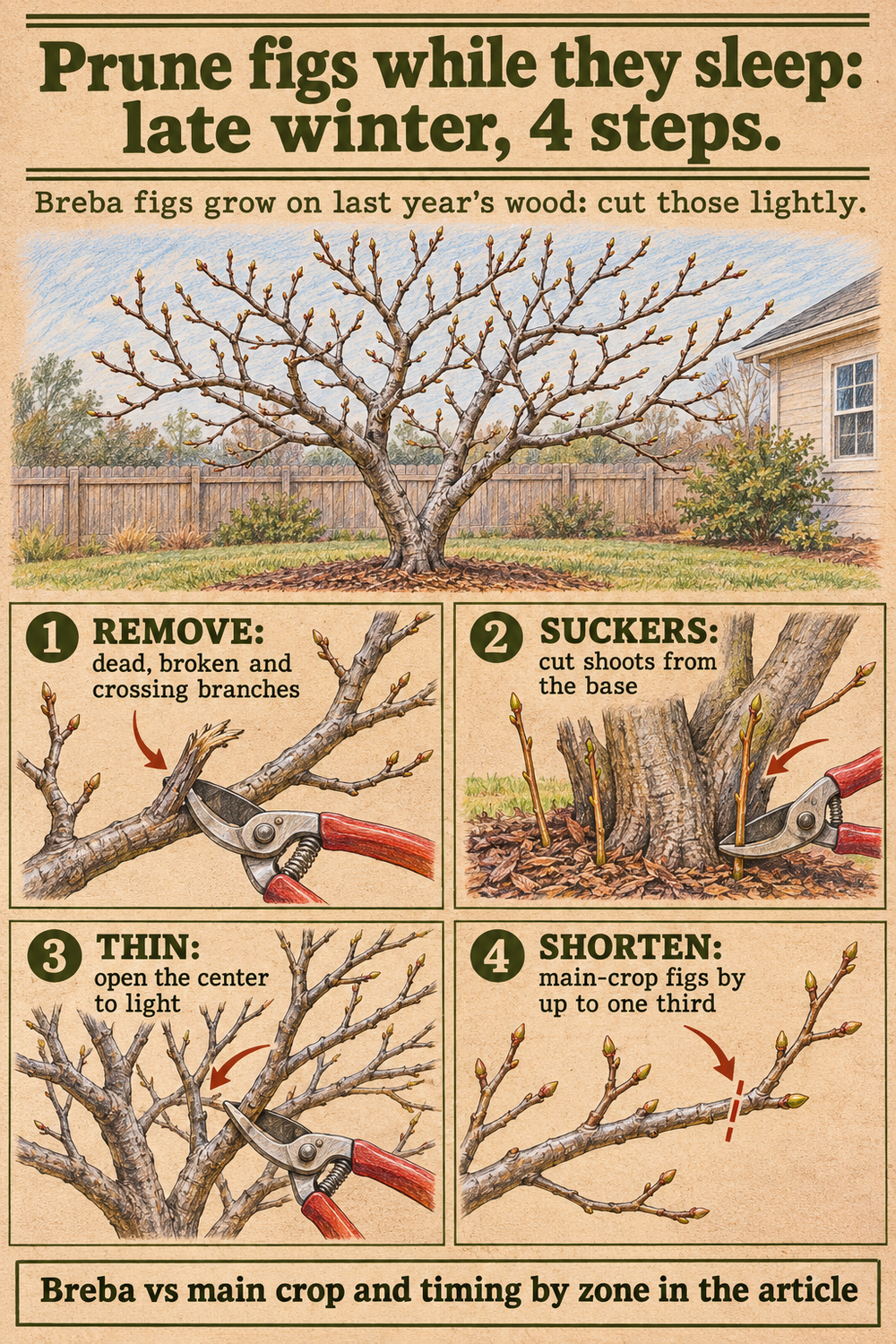
When to prune fig trees depends on which crop you want to keep. Most figs get a light pruning in late winter while they’re dormant, but trees that bear an early “breba” crop lose it if you cut them hard in winter. Here’s how to tell, and the 4 steps for a clean dormant prune.
Quick answer
Quick answer: Prune most fig trees in late winter (January-March, before buds swell), while they’re dormant. Remove dead, broken and crossing wood, cut suckers at the base, thin the center and shorten long shoots by up to one third. If your tree bears a breba crop in early summer on last year’s wood, prune it lightly in winter or right after the main harvest instead.
Breba vs main crop: why timing matters
Fig trees (Ficus carica) can fruit twice a year:
| Crop | When it ripens | Grows on | What winter pruning does |
|---|---|---|---|
| Breba | early summer | last year’s wood | heavy winter pruning removes it |
| Main crop | late summer to fall | this year’s new growth | winter pruning barely affects it |
The University of California IPM program notes that mature figs bear the main crop on current-season growth, so dormant pruning matters less for figs than for most fruit trees. UC Master Gardeners advise that trees grown for their breba crop should not be pruned heavily in winter, but just after the main crop is picked.
How to know if your fig makes brebas: Look for small figs forming on bare branch tips in early spring, before the leaves are fully out. Many popular varieties (Brown Turkey, Desert King) make some brebas; some make almost none. Check your variety’s label or nursery listing.
That one check decides whether you follow the steps below in February or wait until fall.
How to prune a fig tree in late winter (4 steps)
What you need
- Clean, sharp bypass pruners and loppers (a pruning saw for limbs over 1 inch)
- Gloves and long sleeves: fig sap can irritate skin
- Rubbing alcohol to wipe blades between trees
Step 1: Remove dead, broken and crossing branches
Start with the easy cuts. Dead wood is gray and brittle and shows no green under the bark. Cut back to healthy wood or the branch collar.
Step 2: Cut suckers at the base
Shoots from the roots or the base of the trunk steal energy. Cut them flush with the ground unless you’re growing your fig as a multi-stem shrub (common in zones 7-8, where frost can kill the top).
Step 3: Thin the center for light
Remove a few branches growing into the middle of the tree. Sunlight and air in the center ripen fruit and reduce disease.
Step 4: Shorten long shoots by up to one third
On main-crop figs, cut long, leggy branches back by up to one third, just above an outward-facing bud. On breba-bearing trees, skip this step in winter or keep it very light.
Never remove more than about 25-30% of a mature tree in one year.
When to prune fig trees by zone
| Zone | Best time | Notes |
|---|---|---|
| 7 | late February-March, after hard frosts | figs may die back; wait to see what survived, then cut dead wood |
| 8 | February | protect young trees on very cold nights |
| 9-10 | January-February | trees grow fast; a second light trim in summer is OK |
| 6 and colder | figs are usually grown in pots and stored for winter | prune when you bring them out in spring |
Find your zone on the USDA Plant Hardiness Zone Map.
Beginner mistakes
- Pruning in fall. Fresh cuts before winter invite cold damage.
- Topping the tree flat. It forces a flush of weak shoots. Cut back to a bud or branch instead.
- Heavy winter cuts on a breba variety. You lose the early figs.
- Summer pruning big branches. UC notes that summer pruning releases more irritating sap and can cost fruit.
Frequently Asked Questions
Can you prune a fig tree in summer?
Light pinching of shoot tips is fine. Save structural pruning for the dormant season or right after harvest.
How much can I cut back an overgrown fig?
Spread it over 2-3 years, removing about a quarter of the oldest wood each winter.
Why is my fig tree not producing fruit after pruning?
Usually heavy winter pruning on a breba variety, too much shade, or a young tree (figs often start fruiting at 2-3 years).
Do I need to seal pruning cuts?
No. Clean cuts close on their own; sealants are not recommended for most fruit trees.
In Short
- Most figs: light dormant pruning in late winter, in 4 steps.
- Breba-bearing figs: light winter cuts, or prune after the main harvest.
- Never remove more than about a quarter of the tree in a year.
You might also like: How to prune rosemary · Winter garden hacks
Sources: UC IPM, Pruning and thinning fig trees; UC Master Gardeners of San Luis Obispo County, Figs; University of Florida IFAS, The Fig (MG214); USDA zone map.