
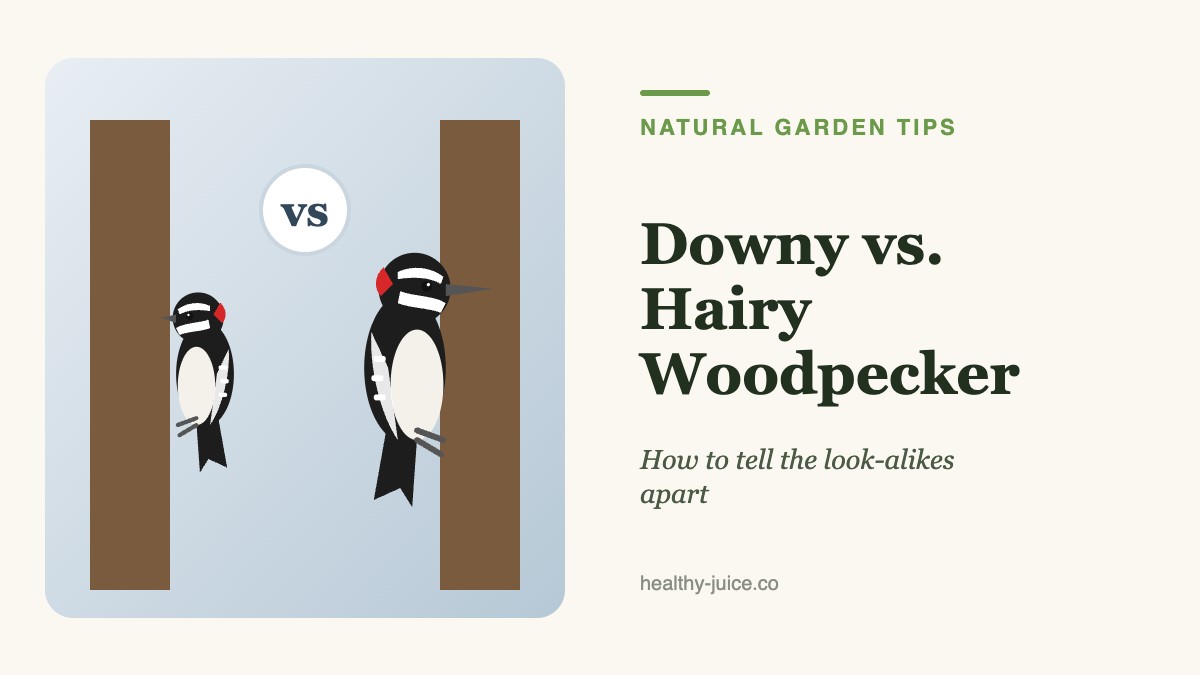
Few bird-identification puzzles are as persistent as the Downy and Hairy Woodpecker. Both are black and white, both males can show a red patch at the back of the head, and both can disappear around a tree trunk just when you think you have the answer.
They are so similar that even experienced birders double-check. The good news is that a handful of reliable clues, used together, make these look-alikes much easier to separate. This guide walks you through each clue, from the bill to the voice, so you can identify them with confidence at your feeder or in the woods.
Why Are They So Similar?
Despite their nearly identical plumage, Downy and Hairy Woodpeckers are not each other’s closest relatives. Their resemblance is a fascinating example of convergence, and scientists continue to study why the two species look so alike. Whatever the reason, the similarity means you need to look beyond the overall pattern.
Clue 1: Bill Length (The Best Clue)
Start with the bill. This is the single most useful field mark.
- Downy Woodpecker: A short, delicate bill that is clearly shorter than its head. It is often about one-third the length of the head, giving the bird a cute, stubby look.
- Hairy Woodpecker: A much longer, sturdier bill, roughly the length of its head, giving it a more chisel-like, serious look.
Compare the bill with the distance from the base of the bill to the back of the head. This proportion is reliable even when you cannot judge the bird’s overall size.
Clue 2: Overall Size
- Downy Woodpecker: About 6–7 inches long, close to the size of a sparrow. It is the smallest woodpecker in North America.
- Hairy Woodpecker: About 9 inches long, closer to the size of a robin.
Size can be hard to judge on a lone bird, especially from a distance. It is most helpful when you can compare the bird to something familiar, such as a feeder, a branch, or another bird nearby.
Clue 3: Outer Tail Feathers
Tail feathers can help too:
- Downy Woodpecker: Usually shows black spots or bars on the outer white tail feathers.
- Hairy Woodpecker: Eastern Hairies usually show clean white outer tail feathers without spots.
This clue requires a good view, often from below or when the bird spreads its tail against a trunk. It is less reliable in some regions, so treat it as supporting evidence.
Clue 4: Behavior and Foraging Habits
- Downy Woodpecker: Often works thin branches, twigs, and even weed stems such as goldenrod, where it searches for insect larvae. It is frequently seen hanging from small branches and visits feeders readily.
- Hairy Woodpecker: More often seen on larger trunks and limbs, chipping away at bark with stronger strokes.
These are tendencies, not rules. Both species visit suet feeders and both can forage on trunks.
Clue 5: Voice and Drumming
Listening can be just as helpful as looking.
- Downy Woodpecker: Gives a soft, flat “pik” call and a whinnying call that descends in pitch.
- Hairy Woodpecker: Gives a sharper, louder “peek!” call and a rattling call that stays more level rather than descending.
Both species drum to communicate, and Hairy Woodpeckers generally drum faster than Downies. Learning the calls can help you identify birds you hear before you see them.
Clue 6: Range and Habitat
Both species are widespread across much of North America. Downy Woodpeckers are especially common in backyards, parks, and suburban areas. Hairy Woodpeckers are often associated with more mature forests, though they also visit backyard feeders.
Regional variation exists. In some western and northern areas, birds may look grayer or browner below, and spotting on the wings or tail can vary. Always consult a regional field guide.
Side-by-Side Comparison
| Feature | Downy Woodpecker | Hairy Woodpecker |
|---|---|---|
| Bill | Short, delicate, shorter than head | Long, sturdy, about head-length |
| Size | 6–7 inches | About 9 inches |
| Outer tail feathers | Usually black spots | Usually clean white (East) |
| Foraging | Thin branches, weed stems | Larger trunks and limbs |
| Call | Soft “pik” | Sharp “peek!” |
| Rattle call | Descends in pitch | Stays more level |
Male or Female?
In both species, males have a small red patch at the back of the head, while females lack it. Young birds may show red or reddish areas on the crown, which can add to the confusion.
Common Identification Mistakes
- Relying on size alone, which is easy to misjudge.
- Checking only one feature, especially from a poor angle.
- Ignoring posture and distance, which can make a bill look longer or shorter than it is.
- Not accounting for regional variation.
Posture, distance, and regional variation can be misleading, so none of these clues should stand alone.
Tips for Better Identification
- Watch at the feeder. Suet feeders give you close, repeated views.
- Take photos. Photos let you study bill length and tail feathers later.
- Listen carefully. Calls and rattles are strong clues.
- Compare side by side. If both species visit your yard, you will quickly notice the differences.
- Use a field guide or birding app to check your conclusions.
Attracting Both Woodpeckers to Your Yard
- Offer suet, especially in colder months.
- Provide peanuts, sunflower seeds, or nut blends.
- Keep mature and dead trees when safe.
- Plant native trees and shrubs that support insects.
Frequently Asked Questions
Which is more common, Downy or Hairy Woodpecker?
In most backyards, the Downy Woodpecker is more common. Hairy Woodpeckers are widespread but often less numerous and more tied to larger trees.
Can Downy and Hairy Woodpeckers be seen together?
Yes. Both species often visit the same suet feeders, which is one of the best opportunities to compare their size and bill length side by side.
Do both species have red on the head?
Only the males of both species have a small red patch on the back of the head. Females are black and white without red.
Final Thoughts
The Downy versus Hairy Woodpecker puzzle has stumped many backyard birders, but it does not have to stump you. Start with the bill, then check size, tail feathers, behavior, and voice. Put several clues together, and the look-alikes become much easier to separate.