
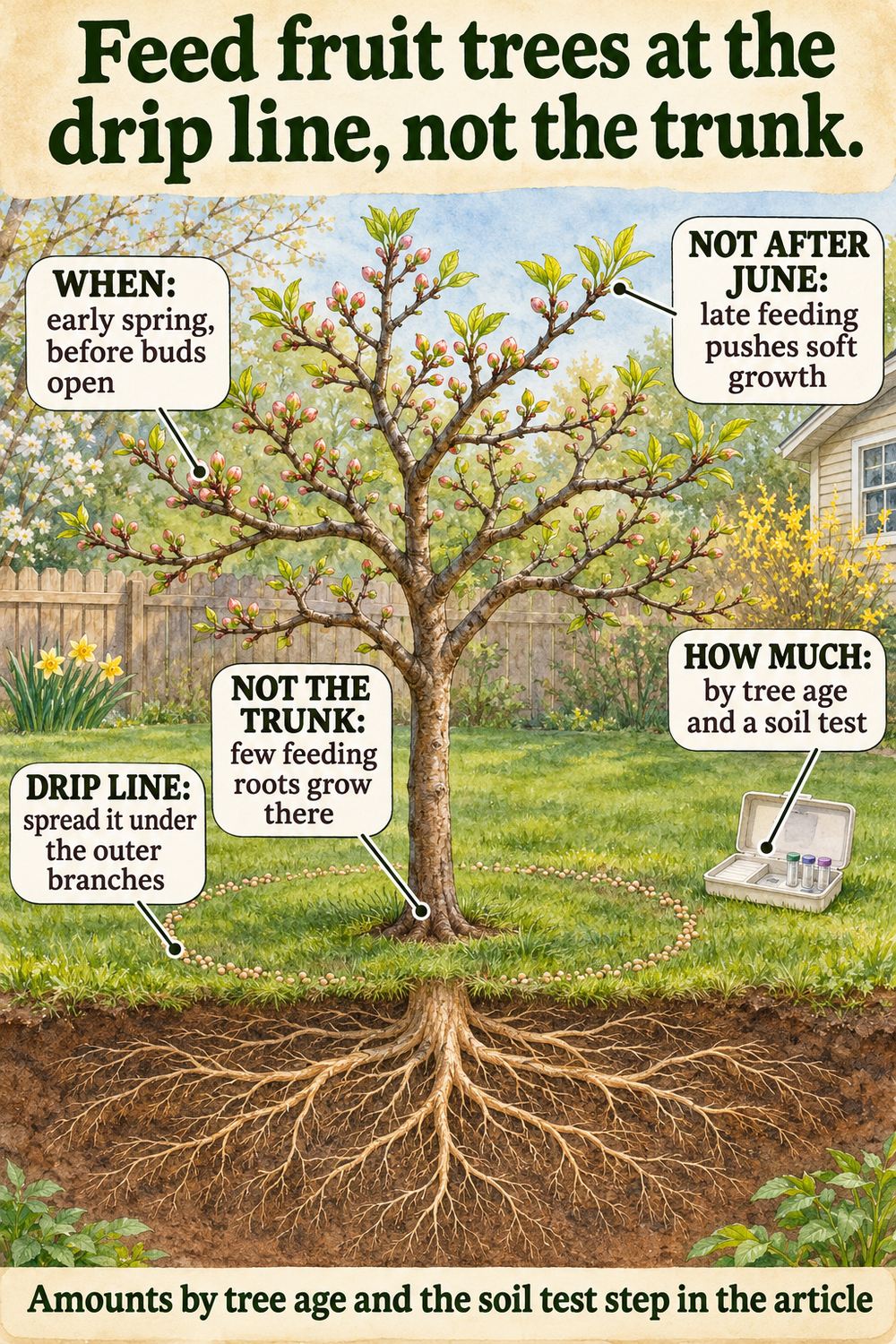
How to fertilize fruit trees the right way: spread fertilizer under the outer branches and a little beyond, where the feeding roots are, not against the trunk. Do it in early spring, base the amount on a soil test, and stop by early summer. Below: the steps, amounts by tree age, and the mistakes that cost fruit.
Quick answer
Quick answer: Test your soil first. In late winter or early spring, before buds open, scatter a balanced or nitrogen fertilizer in a ring from about halfway out under the canopy to a little past the drip line (the edge of the branches), keeping it away from the trunk. Use roughly 1/10 pound of actual nitrogen per year of tree age as a starting point, follow your soil test, and don’t fertilize after June.
Why the drip line?
The feeding roots that take up water and nutrients spread out wide, often well beyond the branch tips. Near the trunk there are mostly thick, woody roots that absorb little. Extension services such as LSU AgCenter advise spreading fertilizer around the drip line and avoiding placing it right next to the trunk.
When to fertilize fruit trees
| Timing | Why |
|---|---|
| Late winter to early spring, as growth resumes | roots can use nutrients right as leaves and blossoms form |
| Not after about June | late feeding pushes soft growth that may not harden off before winter |
North Carolina Extension puts it in late February to early March in the Southeast; in colder zones, early spring before bud break.
When to fertilize fruit trees by type
| Tree | Timing |
|---|---|
| Apples and pears | early spring, before bud break |
| Peaches and plums | at bud swell to just after bloom (check your extension office) |
| Citrus (zones 9-10) | late winter, plus 2 later feedings in spring and summer |
The rates below are for apples, pears, peaches and plums; citrus and nut trees have their own guidelines.
Start with a soil test
A soil test tells you the pH and which nutrients are actually missing, so you don’t add what isn’t needed. Your county extension office sells test kits or can tell you where to send a sample. UNH Extension suggests retesting about every 3 years.
The test is the step most home growers skip, and it decides how much you need.
Reading your soil test
- pH: most fruit trees grow best at about 6.0-6.5. The report tells you how much lime (to raise) or sulfur (to lower) to add.
- Nitrogen: follow the lab’s recommendation for fruit trees.
- Phosphorus and potassium: if the report says “high” or “optimum”, skip them and use a nitrogen-only fertilizer (UNH Extension).
How much fertilizer?
Rates depend on your soil, tree type and growth, so treat these as a starting point and adjust to your soil test:
| Tree age | Actual nitrogen per year (approx.) | Example with a 10-10-10 fertilizer |
|---|---|---|
| 1 year | 0.1 lb | about 1 lb of 10-10-10 |
| 3 years | 0.3 lb | about 3 lb |
| 5 years | 0.5 lb | about 5 lb |
| Mature (8+ years) | up to about 0.8-1 lb, depending on growth | up to 8-10 lb |
Check the growth: if a bearing tree puts on more than about 12-18 inches of new shoot growth a year, reduce or skip nitrogen. Too much fertilizer can cause leafy growth at the expense of fruit (NC State Extension).
How to fertilize fruit trees, step by step
What you need
- Your soil test results
- A balanced fertilizer (such as 10-10-10) or what the test recommends
- A scale or measuring cup, a rake
Steps
- Pull back mulch under the tree.
- Measure the amount for your tree’s age.
- Scatter it evenly in a ring, from about halfway between the trunk and the drip line to a foot or two beyond the drip line.
- Keep it at least 1 foot from the trunk.
- Rake it in lightly and water well if no rain is expected.
- Replace the mulch, keeping it a few inches from the trunk.
Mistakes to avoid
- Piling fertilizer against the trunk. Little is absorbed there, and it can damage bark.
- Fertilizing at planting time with strong granular fertilizer. Wait until the tree has started growing.
- Feeding in late summer or fall. It pushes soft growth into winter.
- Lawn fertilizer with weed killer under trees: it can harm them.
- Guessing instead of testing. Extra phosphorus and potassium build up and don’t help.
Organic options
Well-rotted compost or aged manure spread in a ring at the drip line in early spring feeds trees slowly. Blood meal or feather meal add nitrogen. Use the same timing rules.
Frequently Asked Questions
What is the best fertilizer for fruit trees?
The one your soil test calls for. Many trees need mainly nitrogen. Without a test, a balanced fertilizer is a stop-gap for one season; test before repeating.
Do young fruit trees need fertilizer?
Often a little in their first years to build size, but not at planting.
Can I fertilize fruit trees in fall?
It’s usually not recommended because of the risk of soft, frost-tender growth.
How do I find the drip line?
Look straight down from the tips of the outermost branches. That circle on the ground is the drip line.
In Short
- Feed at the drip line, not the trunk.
- Early spring, from a soil test, about 1/10 lb nitrogen per year of age as a start.
- Nothing after June; watch shoot growth and adjust.
You might also like: Plants that thrive under trees · The garlic growth cycle
Sources: UNH Extension, Fertilizing Fruit Trees; LSU AgCenter, Fertilizing Fruit Trees in Late Winter; NC State Extension (Wayne County), Fertilizing Tree Fruits & Pecans; Michigan State University Extension, Spring fertilization of garden fruits.