
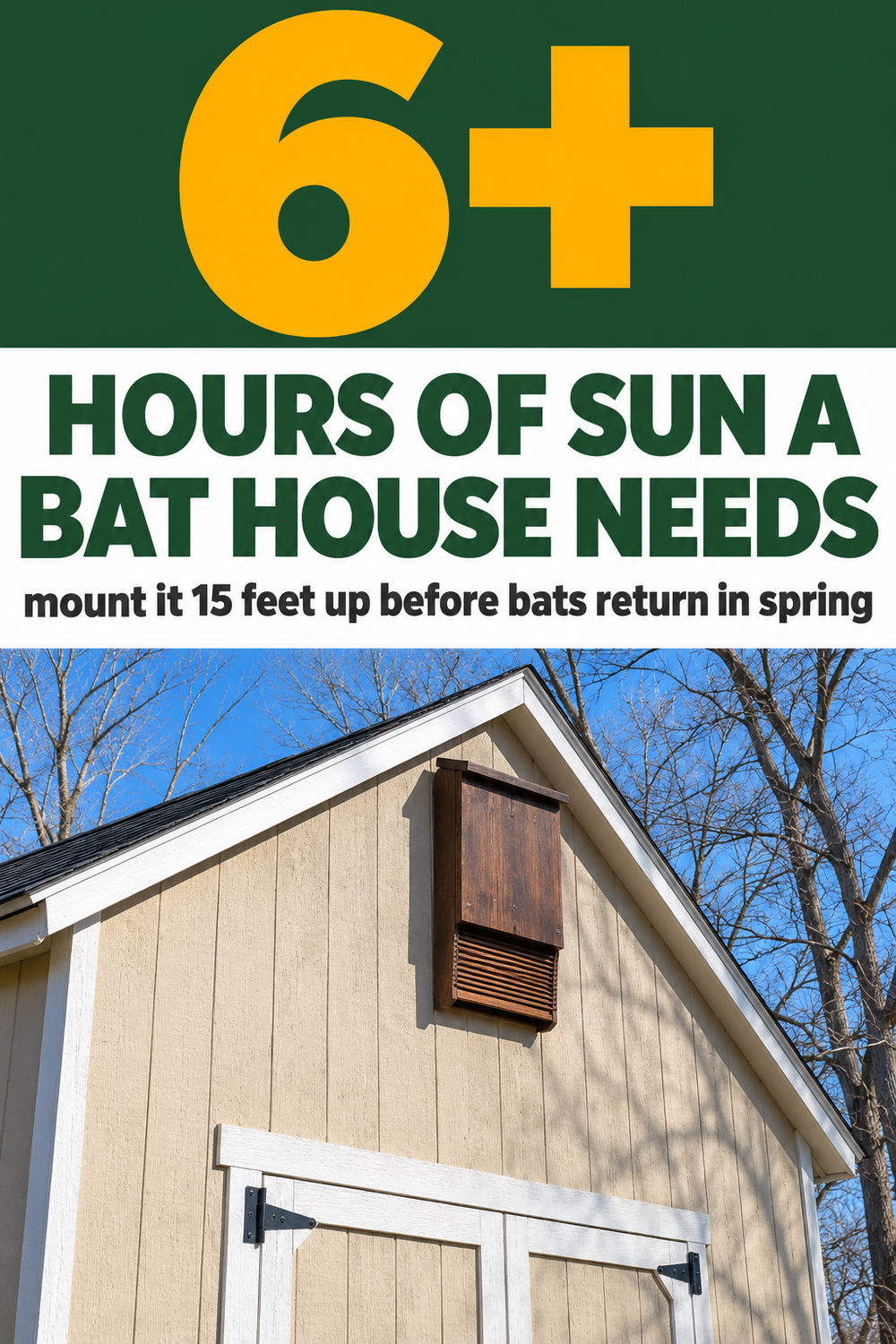
A bat house that stays empty usually has a placement problem, not a building problem. Bats choose warm, sunny, high, open spots. Put yours up in winter, before bats return in spring, and give it the conditions below.
Quick answer
Quick answer: Mount it on a building or a sturdy pole, not a tree, at least 15 feet up, where it gets 6 or more hours of direct sun a day, facing east, southeast or south, with about 20 feet of open flying space around it. Choose a darker color in cool climates and a lighter one in hot climates. Never handle bats.
Why bats need a warm box
In summer, female bats gather in maternity colonies to raise their pups, and the pups need warmth. Guidance based on Bat Conservation International’s research says the most frequent reason a bat house fails is the wrong exposure to the sun. A shaded box stays too cool, so bats ignore it.
That’s why placement matters more than the plan.
Where to put a bat house
On a building or a pole, not a tree
Wooden, brick or stone walls with good sun exposure are excellent spots, and a sturdy pole works too. Boxes on live trees are used much less: leaves shade them and branches make it easy for predators to reach them.
At least 15 feet up
The National Wildlife Federation and UC Master Gardeners give 15 feet as the minimum height. Higher is better, as long as you can mount it safely.
6+ hours of direct sun
At least 6 hours of direct sun a day; in most of the US, more is better. If you only have partial sun, choose a spot with morning sun. Face it east, southeast or south.
Open flying space
Leave about 20 feet of open space in front and around it, away from branches, wires and bright outdoor lights. A pond, stream or wetland within about a quarter mile is a plus: bats drink on the wing and hunt insects over water.
Which color works best?
| Your typical July high | Color |
|---|---|
| below about 85°F (northern and mountain areas) | black or dark brown |
| 85-95°F | dark or medium brown, dark gray |
| 95-100°F | medium tones, light brown |
| above 100°F (desert Southwest) | light colors, white |
Paint the outside only, with exterior latex paint, and never use pressure-treated wood, which may be toxic to bats.
What a good box looks like
- Tall and wide: at least 24 inches tall and 14 inches wide; multi-chamber houses are warmer and more stable.
- Roughened landing plate at the bottom, extending a few inches below the entrance.
- Inside grooves or mesh so bats can grip.
- Narrow chambers, about 3/4 to 1 inch.
- Outdoor-grade plywood or wood, caulked seams, no openings at the top.
When to put it up
Mount it in winter or early spring, before bats come back from hibernation or migration. Bats can take a season or two to move in; if it’s still empty after two summers, try a sunnier or higher spot.
Mistakes to avoid
- Mounting it in the shade or on a tree.
- Too low (under 15 feet) or near bright lights.
- A tiny, single-chamber box in a cold climate.
- Using pressure-treated wood or painting the inside.
- Using insecticides in the yard: bats eat flying insects.
Bat safety
Bats are beneficial, but never touch or handle a bat, alive or dead. If you find a grounded bat or have a bat in your home, contact your state wildlife agency or a licensed wildlife rehabilitator. Bats can carry rabies, and any bite or scratch needs a doctor right away.
Frequently Asked Questions
Will this attract bats into my home?
They give bats that already live nearby a better place to roost. A box on an outside wall doesn’t make bats move indoors.
How long until bats move in?
Often the first or second summer, if the conditions are right.
Should I clean it?
Usually not. Check it in late winter for wasp nests and clear them out before bats return.
Will bats eat mosquitoes?
Bats eat many night-flying insects, including moths and beetles; mosquitoes are part of the diet for some species.
In Short
- Building or pole, at least 15 feet up, 6+ hours of sun.
- Color to match your climate, 20 feet of open space.
- Put it up in winter; never handle bats.
You might also like: Types of woodpeckers · Winter garden hacks
Sources: National Wildlife Federation, How to Build a Bat House; University of Florida IFAS Gardening Solutions, Bat Houses; Rutgers NJAES Fact Sheet FS1269; UC Master Gardeners of San Luis Obispo County.