
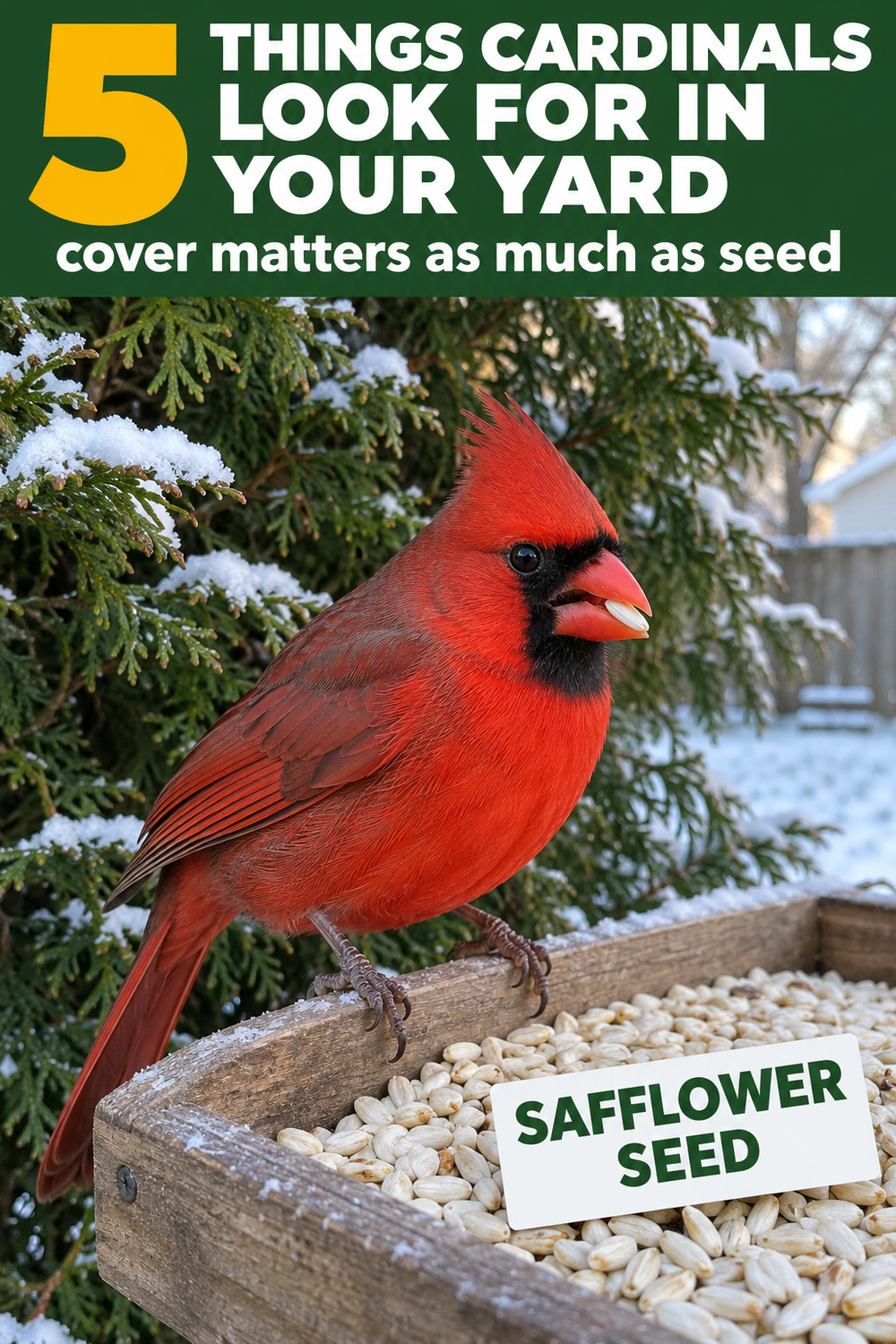
How to attract cardinals comes down to five things: the right seed, a feeder they can stand on, dense cover nearby, water, and food at the times they feed. Cardinals don’t migrate, so a yard that offers all five can host them all year. Here’s what each one means in practice.
Quick answer
Quick answer: Offer safflower and black oil sunflower seed on a tray or a hopper with a ledge, plant dense shrubs or evergreens within about 10 feet, keep fresh water out (ice-free in winter), and make sure feeders are full at dawn and dusk, when cardinals are most active.
1. The right seed
Cardinals have thick, strong bills made for cracking seeds.
| Food | Why cardinals like it |
|---|---|
| Safflower | a favorite; many squirrels and starlings dislike it |
| Black oil sunflower | high fat, easy to crack |
| Striped sunflower | thicker shell, but cardinals manage it |
| Cracked corn | eaten, but attracts many other birds |
| Fruit and berries | from native shrubs in fall and winter |
In summer, cardinals also eat many insects, which they feed to their young.
2. A feeder they can stand on
Cardinals prefer to feed on a flat surface. A platform or tray feeder, a hopper with a wide ledge, or a tray under your tube feeder suits them much better than a small tube with tiny perches. Place it 4-5 feet off the ground.
3. Dense cover nearby
This is the part many people miss. Cardinals feel safe close to thick shrubs, hedges, brambles or evergreens, where they can dart for cover and spend the night. Audubon notes that undergrowth along the edges of a yard can even lead them to nest on your property.
Good choices: native viburnums, dogwood shrubs, eastern red cedar, holly and other dense natives. See native shrubs that provide berries and shelter.
Seed brings them in; cover makes them stay.
4. Water
A bird bath, ideally with gently sloping sides and water no deeper than 2-3 inches. In winter, a heated bath or de-icer keeps it open.
5. Food at the right time
Cardinals often visit feeders early in the morning and again at dusk. Fill feeders in the evening so seed is waiting at first light.
What do cardinals eat in each season?
| Season | Main foods | What to offer |
|---|---|---|
| Winter | seeds, dried berries | safflower, sunflower, water |
| Spring | seeds, buds, first insects | keep feeders full during nesting |
| Summer | insects, seeds, fruit | water, insect-friendly native plants |
| Fall | seeds, berries, fruit | berry shrubs, sunflower |
How to tell male and female cardinals apart
- Male: bright red all over, black mask around the red bill, red crest.
- Female: warm tan-brown with red tinges on the wings, tail and crest, and the same orange-red bill.
- Young birds: like the female, but with a dark bill.
How to attract cardinals: mistakes to avoid
- Only tube feeders with small perches.
- No shrubs or cover anywhere near the feeder.
- Empty feeders at dawn.
- Cats roaming near the feeding area.
- Feeders right next to a window without decals (window strikes).
Frequently Asked Questions
Do cardinals come back to the same yard?
Yes. Cardinals don’t migrate and often stay in the same area year-round when food and cover are there.
What color feeder attracts cardinals?
Color matters less than the feeder style. A sturdy tray or a hopper with a ledge works best.
Will cardinals use a bird house?
No. Cardinals build cup nests in dense shrubs and tangles, not in boxes.
Why do cardinals attack windows?
In spring, males see their reflection as a rival. Cover the outside of the window or add decals for a few weeks.
In Short
- Safflower and sunflower on a tray or ledge feeder.
- Dense shrubs within about 10 feet.
- Water, and full feeders at dawn and dusk.
You might also like: Native shrubs with winter berries · Downy vs hairy woodpecker
Sources: National Audubon Society, How to Attract Northern Cardinals to Your Home; Cornell Lab of Ornithology, All About Birds (Northern Cardinal); Minnesota DNR, Northern Cardinal.