
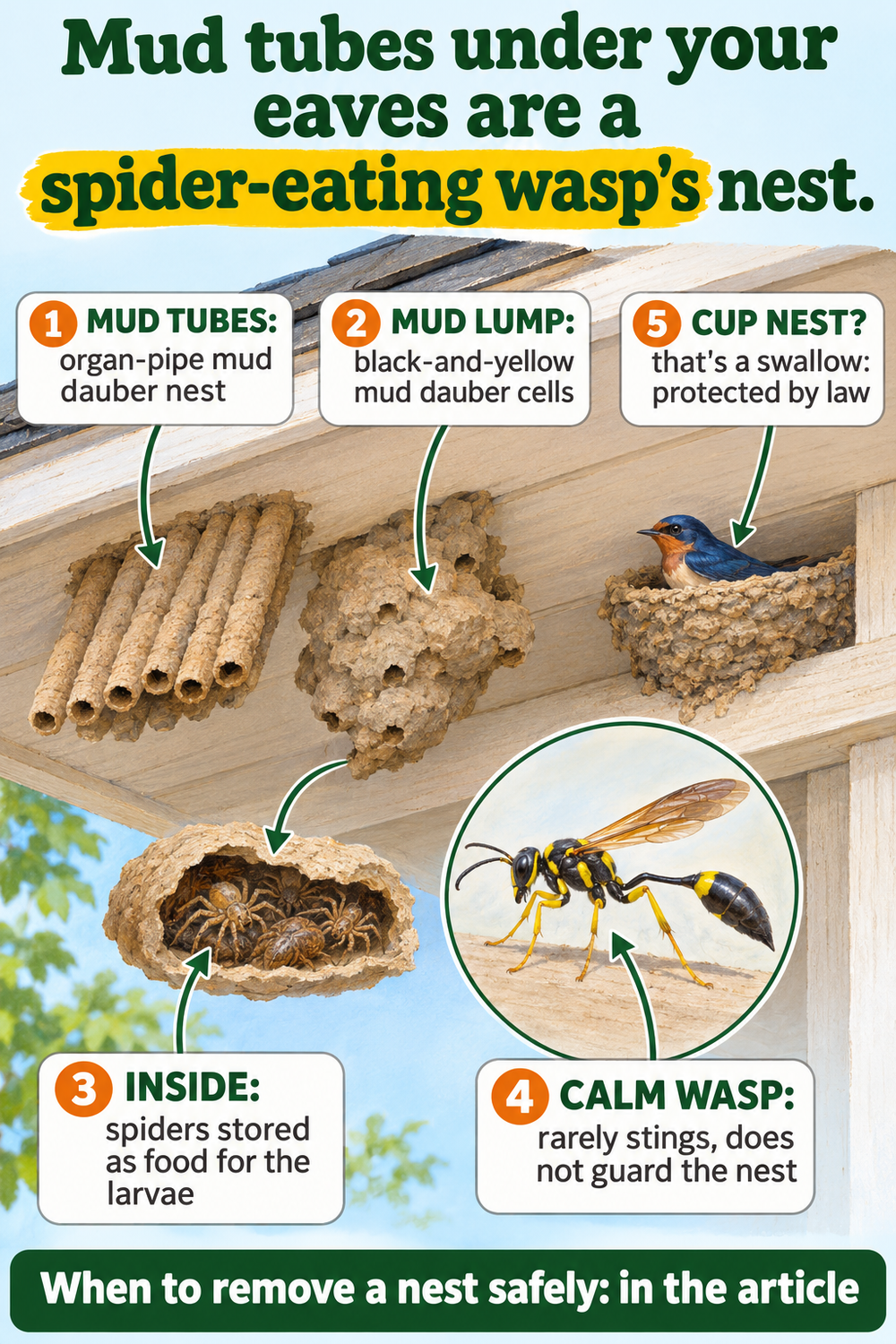
A mud dauber nest is the row of mud tubes or the lumpy mud mass you find under eaves, on porch ceilings and in sheds. The builders are calm, solitary wasps that hunt spiders and rarely sting. Here’s how to identify the nest, how it differs from a protected swallow nest, and when to remove it.
Quick answer
Quick answer: Long parallel mud tubes = organ-pipe mud dauber. A lumpy mud mass = black-and-yellow mud dauber. Inside are cells stocked with paralyzed spiders for the larvae. Mud daubers are solitary, don’t defend their nests and rarely sting. Scrape off empty nests in winter. A cup-shaped mud nest belongs to swallows, which are protected by federal law: leave active bird nests alone.
How to identify a mud dauber nest
| Nest | What it looks like | Who made it |
|---|---|---|
| Organ-pipe tubes | several long, narrow mud tubes side by side, like organ pipes | organ-pipe mud dauber (Trypoxylon) |
| Lumpy mud mass | a rough, fist-sized lump of mud cells, often smoothed over | black-and-yellow mud dauber (Sceliphron caementarium) |
| Reused old nests | cells with round holes, sometimes plugged | blue mud dauber, which reuses other daubers’ nests |
| Cup nest with an open top or a gourd shape | mud pellets mixed with grass, often with feathers | barn swallow or cliff swallow, not a wasp |
Look for small round holes: that means the adults have already emerged and the nest is empty.
What’s inside the mud
Each cell holds one egg and several spiders that the female wasp stung and paralyzed. When the larva hatches, it eats the spiders, spins a cocoon and later chews its way out. The blue mud dauber is known for catching black widow spiders.
That’s why many gardeners are happy to leave them be.
Are mud daubers dangerous?
Not really. Extension services agree:
- Clemson HGIC: solitary and non-aggressive, they rarely sting unless threatened.
- University of Minnesota: solitary wasps don’t defend their nests, so the risk of stings is little to none.
- Texas A&M: capable of stinging, but rarely aggressive.
Unlike yellowjackets and paper wasps, a mud dauber won’t come out to defend its nest. Stings usually happen only when one is trapped against skin. People with a known wasp allergy should still be careful.
Mud dauber or swallow? Why it matters
Barn swallows and cliff swallows also build mud nests under eaves and on porches, but theirs are cups or gourd shapes made of mud pellets, lined with grass and feathers. Swallows are native birds protected by the Migratory Bird Treaty Act: it is illegal to destroy an active nest with eggs or young. If you see a cup-shaped nest, leave it, and wait until the birds are gone before cleaning the area.
How to remove a mud dauber nest
When
In late fall or winter, when the nest is empty or the larvae are dormant. Check for exit holes first.
How
- Wear gloves.
- Scrape the nest off with a putty knife or a paint scraper.
- Wash the spot with soapy water to remove the mud stain.
- No spray is needed: the wasps are solitary, and there is no colony to treat.
Preventing new nests
- Seal gaps around eaves, vents and siding.
- Knock down a new nest early in spring while it’s still small.
- Keep doors to sheds and garages closed in summer.
- Reduce spiders around the house, since they’re the wasps’ food.
Mistakes to avoid
- Spraying insecticide on a mud dauber nest: unnecessary, and the larvae are protected by the mud.
- Confusing a swallow nest with a wasp nest.
- Knocking down a nest in summer without checking for active wasps nearby.
Frequently Asked Questions
Do mud daubers come back to the same nest?
New wasps may reuse or build next to old nests. Removing them in winter keeps the spot clear.
What attracts mud daubers to my house?
Sheltered spots for nests, a source of mud nearby (puddles, wet soil) and plenty of spiders.
Are mud daubers good for the garden?
They reduce spider numbers and visit flowers for nectar, so they’re largely beneficial.
Can mud daubers damage my house?
No structural damage, only mud stains that wash off.
In Short
- Tubes or lumps of mud = mud daubers; cups of mud = swallows.
- Mud daubers rarely sting and don’t defend their nests.
- Scrape off empty nests in winter; never disturb active bird nests.
You might also like: Winter garden hacks · Types of woodpeckers
Sources: Clemson HGIC, Mud Daubers; University of Minnesota Extension, Solitary wasps; Texas A&M AgriLife, Mud Daubers; US Fish and Wildlife Service, Migratory Bird Treaty Act.