
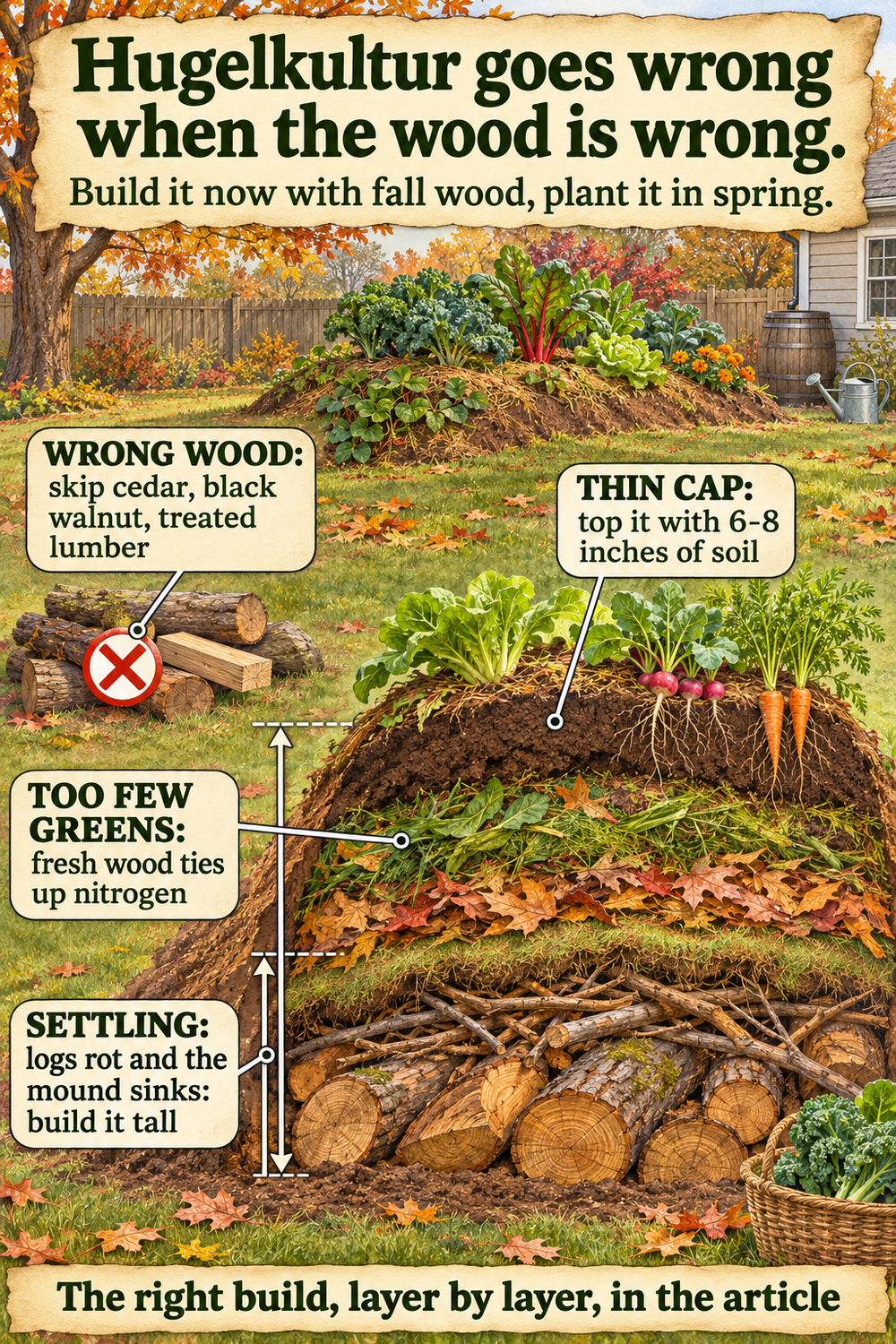
Most hugelkultur mistakes start with the wood: some species slow plant growth, and fresh wood ties up nitrogen. The others are a soil cap that’s too thin and a mound that sinks as the logs rot. Here’s what goes wrong, why, and how to build it right this winter.
Quick answer
Quick answer: Don’t use cedar, black walnut, treated lumber or diseased wood. Add plenty of greens (grass clippings, manure, upside-down sod) to balance the nitrogen that fresh wood ties up, top the bed with 6-8 inches of compost and soil, and build it taller than you want it, because it settles as the wood breaks down.
What is a hugelkultur bed?
A hugelkultur bed is a mound or raised bed built on a core of buried wood. Oklahoma State University describes the typical layers as large logs, then branches and twigs, then grass clippings or manure, then topsoil. As the wood slowly rots, it acts like a sponge for water and a slow source of organic matter.
It’s worth knowing the honest picture: Washington State University Extension points out that most of the claims come from gardeners’ experience rather than peer-reviewed trials. Clemson notes a practical benefit that’s well established: wood fills a deep raised bed, so you need less purchased soil and compost.
Done right, it’s a good use of fallen branches and logs. Done wrong, it can stunt plants for a year or two.
The 6 most common hugelkultur mistakes
Mistake 1: Using the wrong wood
Some woods don’t belong in a growing bed:
| Avoid | Why |
|---|---|
| Black walnut | contains juglone, which stunts tomatoes, peppers and many other plants |
| Cedar, redwood, cypress | rot-resistant: they barely break down and can slow growth |
| Pressure-treated, painted or stained lumber | may contain chemicals you don’t want in food beds |
| Diseased or insect-infested wood | can carry problems into your garden (Clemson) |
| Very fresh pine with lots of resin | slow to break down; fine in small amounts once aged |
Good choices: hardwoods that rot well, such as oak, maple, birch, alder, poplar and fruit-tree wood. Logs that are already soft and partly rotted are best. Not sure what you have? See how to identify oak firewood.
Mistake 2: Too few greens
Wood is carbon-rich. As microbes break it down, they use nitrogen from the surrounding soil, which can leave young plants pale and slow in the first year. Balance it with a thick layer of greens on top of the branches: grass clippings, aged manure, green leaves, upside-down sod or compost.
Mistake 3: A soil cap that’s too thin
Seeds and roots need real soil to start. Top the bed with at least 6-8 inches of good topsoil mixed with finished compost. A thin layer dries out fast and leaves roots reaching straight into raw wood.
Mistake 4: Building it too low
The logs shrink as they rot, so the mound settles, sometimes by a third or more over a few years. Build it taller than your target height and expect to top it up with compost each spring.
Mistake 5: Leaving air pockets
Big gaps between logs dry out the bed and let soil sift down. Pack branches and twigs into the gaps, water each layer as you build, and press it down.
Mistake 6: Planting heavy feeders in year one
The first year, while the wood is still tying up nitrogen, grow crops that cope well: squash, pumpkins, potatoes, beans and peas. Save the hungriest crops for year two or three.
Fix the wood and the greens first; those two cause most first-year problems.
How to build a hugelkultur bed the right way
What you need
- Hardwood logs (4-12 inches thick) and branches
- Twigs, leaves and greens (clippings, manure, sod)
- Finished compost and topsoil for a 6-8 inch cap
- A shovel, a hose and a few hours
Steps
- Mark the bed, about 3-4 feet wide so you can reach the middle. Optionally dig down 12 inches and set the sod aside.
- Lay the largest logs in the bottom. Water them well.
- Fill gaps with branches and twigs. Water again.
- Add greens: the sod upside down, clippings, manure or green leaves, 2-4 inches.
- Cap with 6-8 inches of compost and topsoil.
- Mulch with straw or leaves and let it settle over winter. Plant in spring.
Building in late fall or winter, when branches are easy to find, gives the bed a few months to settle before planting. For a full layer-by-layer walk-through, see build a raised hugelkultur garden bed.
Frequently Asked Questions
How long does a hugelkultur bed last?
It changes as the wood breaks down; large hardwood logs can take many years to fully decompose. Expect to add compost every year.
Can I use a whole Christmas tree?
A cut-up pine or fir adds woody material, but use it in moderation and let it age, since conifers are slow and resinous.
Do I need to dig a trench?
No. You can build on top of the ground; a trench just makes the bed lower and helps it hold water.
Does hugelkultur really save water?
Many gardeners report it, and rotting wood does hold water, but formal research is limited. Mulch and good soil still matter.
In Short
- Wrong wood is the biggest mistake: no black walnut, cedar or treated lumber.
- Add greens and a 6-8 inch soil cap to avoid the first-year nitrogen dip.
- Build it tall: it sinks as the logs rot.
You might also like: Build a raised hugelkultur garden bed · Raised garden beds
Sources: Oklahoma State University Extension, Creating a Hugelkultur (HLA-6501); Clemson HGIC, Hügelkultur Gardening; Washington State University Extension, Hügelkultur: What Is It, and Should It Be Used in Home Gardens?