
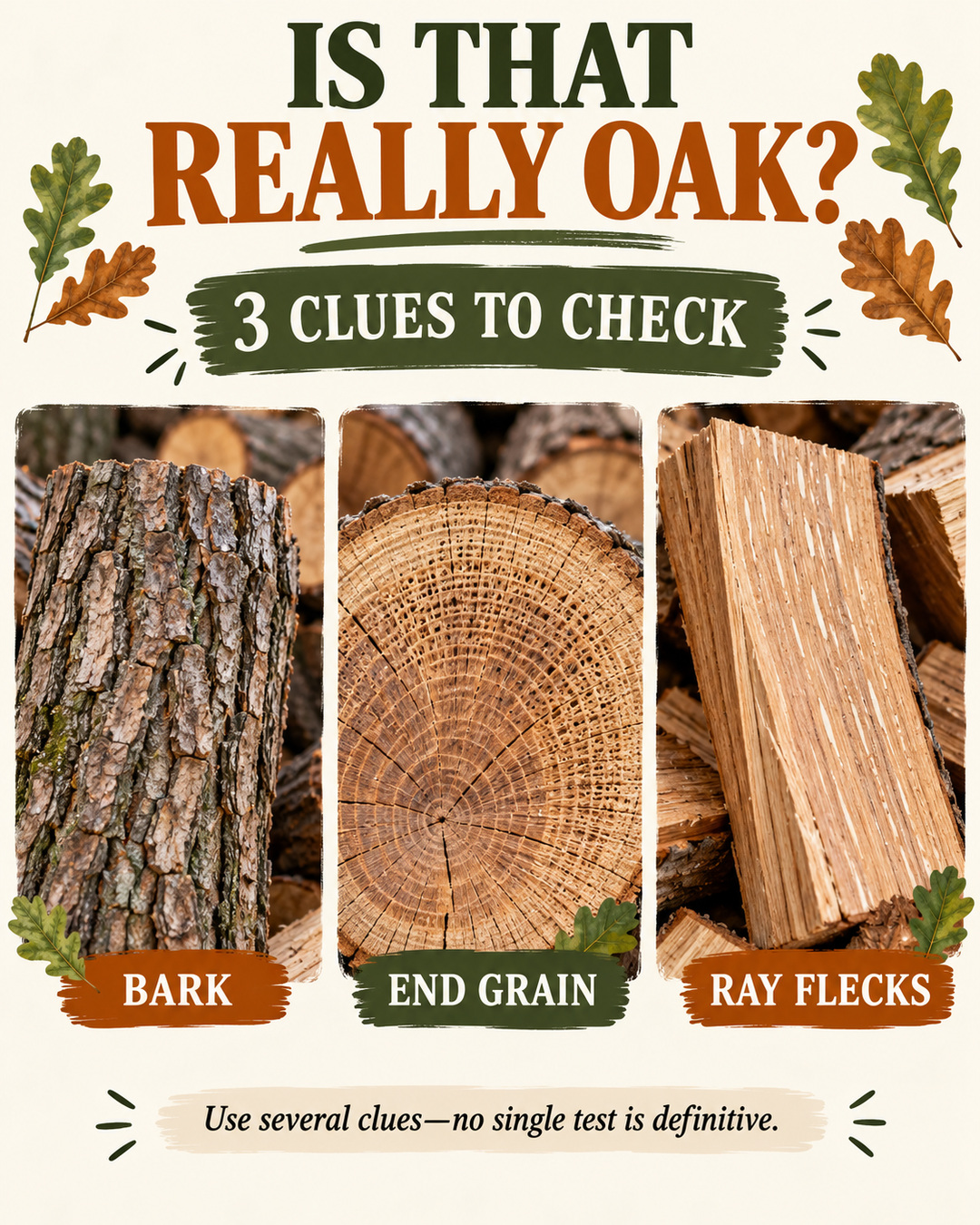
Oak is one of the most prized firewoods: dense, long-burning and great for overnight heat. But when you’re buying a load of split wood, how can you tell whether it’s really oak? No single feature proves it, but checking three clues together will make you much more confident.
Clue 1: The bark
Oak bark is usually thick, rough and deeply textured.
- White oaks tend to have light gray, scaly or flaky bark.
- Red oaks often show darker, ridged bark, sometimes with smoother, shiny stripes running between the ridges.
Bark varies with tree age and species, and it often falls off seasoned wood, so treat it as a supporting clue rather than proof.
Clue 2: The end grain (pores)
Look closely at a clean, freshly cut end of the log. Oak is a ring-porous wood: at the start of each growth ring you’ll see a row of noticeably larger pores, followed by denser wood with smaller pores. This gives the end grain a distinctive ringed pattern.
- In red oak, the large pores are usually open. You can sometimes even blow air through a thin piece.
- In white oak, the pores are mostly plugged, which is why it’s used for barrels.
A sharp knife or a fresh saw cut helps make the pores visible.
Clue 3: Ray flecks on split wood
Oak has large rays, ribbon-like structures that run from the center of the tree outward. On the end grain they appear as thin pale lines radiating from the center. On a split face they can show up as shiny flecks or streaks. Prominent rays are one of the most reliable visual hints that you’re looking at oak.
Why one clue isn’t enough
Other woods such as ash, elm or hickory can share some features with oak. Ash, for example, is also ring-porous but lacks oak’s large rays. By combining bark, end grain and ray flecks, you dramatically reduce the chance of a mistake.
Before you burn: check seasoning
Even genuine oak is a poor fuel if it’s wet. Oak is dense and dries slowly, often needing a year or more after splitting.
- Ask the seller when the wood was cut and split.
- Look for signs of seasoning: cracks (checks) on the ends, darker or grayer color and a lighter weight.
- Knock two pieces together: dry wood sounds hollow, wet wood sounds dull.
- Use a moisture meter on a freshly split face. Aim for roughly 20% or less.
Final thoughts
Identifying oak firewood comes down to observation: rough bark, ring-porous end grain and prominent rays. Combine the clues, check the moisture and you’ll know you’re getting good wood for your money. Save this checklist for your next firewood purchase.