
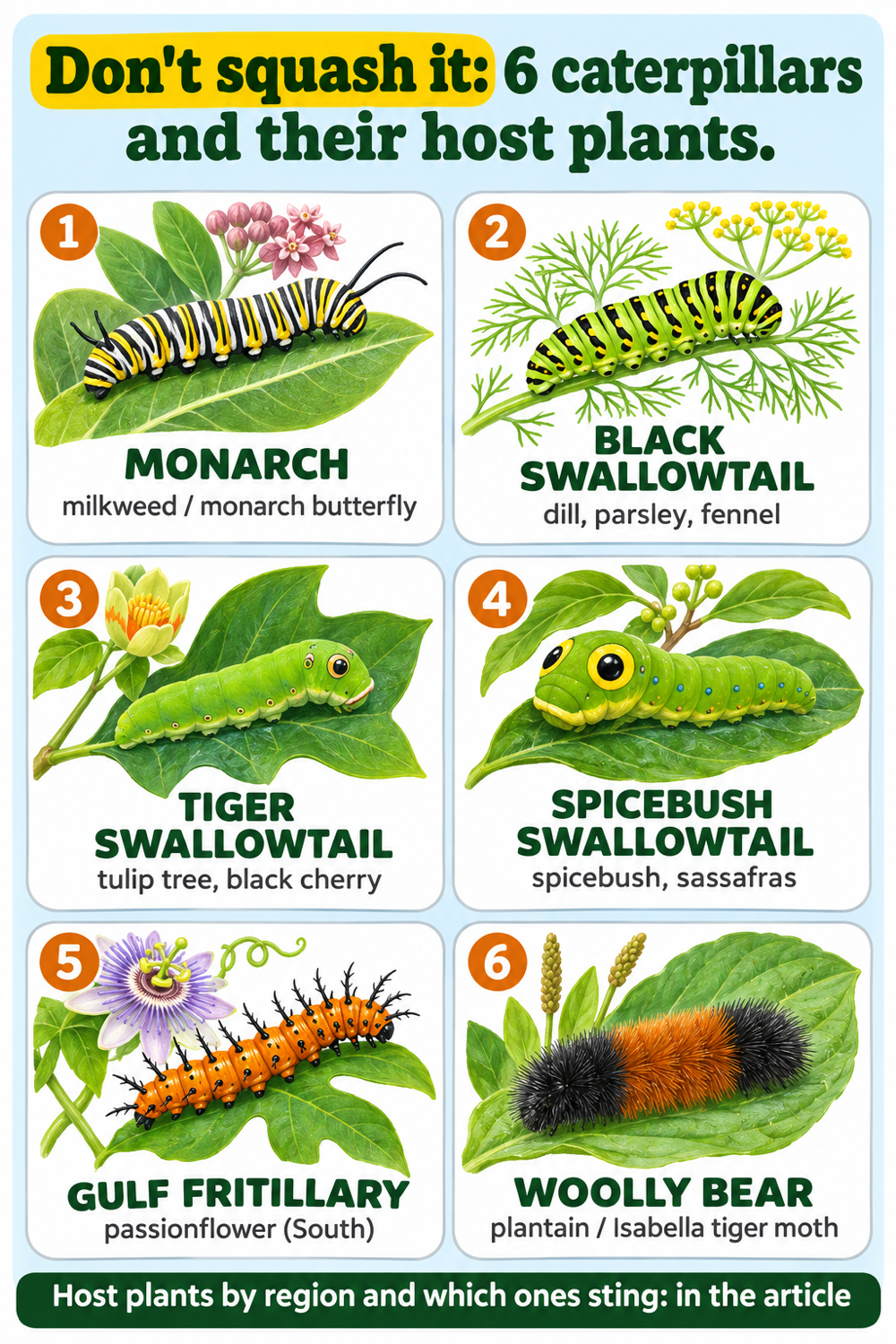
Caterpillar identification saves butterflies: many of the caterpillars gardeners squash on parsley, milkweed or passionflower become the butterflies they planted flowers for. Here are 6 common US caterpillars, the host plant each one needs, what it turns into, and which caterpillars you should never touch.
Quick answer
Quick answer: Monarch (milkweed), Black Swallowtail (dill, parsley, fennel), Eastern Tiger Swallowtail (tulip tree, black cherry), Spicebush Swallowtail (spicebush, sassafras), Gulf Fritillary (passionflower, South) and Banded Woolly Bear (plantain and many low plants; becomes the Isabella tiger moth). Plant their host plants and leave them be.
Why host plants matter
Adult butterflies sip nectar from many flowers, but their caterpillars can usually eat only one plant family. No milkweed, no monarchs. A garden full of flowers but no host plants feeds visitors without raising the next generation.
That’s why knowing who is chewing your parsley matters.
Caterpillar identification: the 6 to know
| Caterpillar | How to recognize it | Host plants | Becomes | Where |
|---|---|---|---|---|
| Monarch | bands of yellow, black and white; black tentacles at both ends | milkweeds (Asclepias) | Monarch butterfly | across the US |
| Black Swallowtail | green with black bands and yellow-orange dots; young ones look like bird droppings | dill, parsley, fennel, carrot, golden alexanders | Black Swallowtail | most of the East and Midwest |
| Eastern Tiger Swallowtail | green, smooth, with small false eyespots behind the head; young ones brown and white | tulip tree, black cherry, ash, birch | Eastern Tiger Swallowtail | East |
| Spicebush Swallowtail | green with large, striking false eyespots | spicebush, sassafras | Spicebush Swallowtail | East |
| Gulf Fritillary | bright orange with black branched spines (harmless) | passionflower vines (Passiflora) | Gulf Fritillary | South, Southwest, coastal California |
| Banded Woolly Bear | fuzzy, black at both ends, rusty-brown in the middle | plantain, dandelion, clover, many low plants | Isabella tiger moth | across the US |
Monarch
The best-known caterpillar in America. Females lay eggs only on milkweed, and the caterpillars eat nothing else. Choose a milkweed native to your region: common milkweed in the Northeast and Midwest, swamp milkweed for wet soil, butterfly weed for dry sunny spots. The Monarch Joint Venture keeps regional lists.
Black Swallowtail
Found on parsley, dill and fennel in vegetable gardens. Plant a little extra parsley or dill for them. When disturbed, they push out a forked orange “osmeterium” with a strong smell: harmless, just a warning.
Eastern Tiger Swallowtail and Spicebush Swallowtail
These two look alike: green with false eyes. The tiger’s eyespots are small; the spicebush’s are large and dramatic. Both often rest in a folded leaf. Their host trees and shrubs are good native plants for wildlife yards.
Gulf Fritillary
Its spines look fierce but don’t sting. In the South, a passionflower vine can be covered in them in late summer and recover.
Banded Woolly Bear
The fuzzy caterpillar crossing the road in fall. It spends winter as a caterpillar under leaf litter and becomes the Isabella tiger moth in spring. Leaving fallen leaves in beds gives it and many other insects a place to overwinter (Xerces Society).
Caterpillars you should not touch
A few common caterpillars have stinging hairs or spines. Admire them, but don’t pick them up:
- Saddleback caterpillar: green “saddle” with a brown center and spiny horns.
- Puss caterpillar (southern flannel moth): looks like a tuft of soft fur, but has some of the most painful stings in the US.
- Io moth caterpillar: bright green with branching spines.
- Hag moth caterpillar: hairy, with odd arm-like lobes.
General rule: if a caterpillar is very hairy or spiny and you don’t know it, don’t touch it. Wear gloves when weeding or pruning where you’ve seen them. If you get stung, wash the area and use tape to lift off broken spines, or call Poison Control at 1-800-222-1222; seek medical care for a strong reaction.
The woolly bear is fuzzy but doesn’t sting, though its hairs can irritate sensitive skin.
Host plants by region
| Region | Host plants to start with |
|---|---|
| Northeast and Midwest | common or swamp milkweed, dill and parsley, black cherry, spicebush |
| South | milkweeds, passionflower, tulip tree, spicebush, sassafras |
| Southwest | native milkweeds (such as antelope horns), passionflower, fennel |
| West | native milkweeds (such as showy or narrowleaf), fennel and parsley, plantain |
How to plant for caterpillars
- Pick 2-3 host plants from the table that grow in your region.
- Plant them in sun, near nectar flowers for the adults.
- Skip pesticides, including “organic” ones like Bt, on host plants.
- Expect chewed leaves. That’s the point.
- Leave leaves and stems over winter: many butterflies and moths spend winter as eggs, caterpillars or chrysalises in the garden.
Frequently Asked Questions
Are caterpillars bad for my garden?
Most do little lasting damage. A few (tomato hornworms, cabbage worms) are crop pests; the ones on this list are butterflies and moths worth keeping.
Can I move a caterpillar to a better plant?
Only to the same kind of host plant. A monarch caterpillar moved to parsley will starve.
What do I do if caterpillars eat all my parsley?
Plant more next year: one plant for you, one for them.
When do I see caterpillars?
Mostly late spring through fall; in the South, almost all year.
In Short
- 6 to know: monarch, black, tiger and spicebush swallowtails, gulf fritillary, woolly bear.
- Each needs its own host plant: plant them and skip pesticides.
- Don’t touch unknown hairy or spiny caterpillars.
You might also like: Native perennials to attract hummingbirds · Native shrubs with winter berries
Sources: Poison Control (National Capital Poison Center); Monarch Joint Venture; Butterflies and Moths of North America; Xerces Society, Leave the Leaves.