
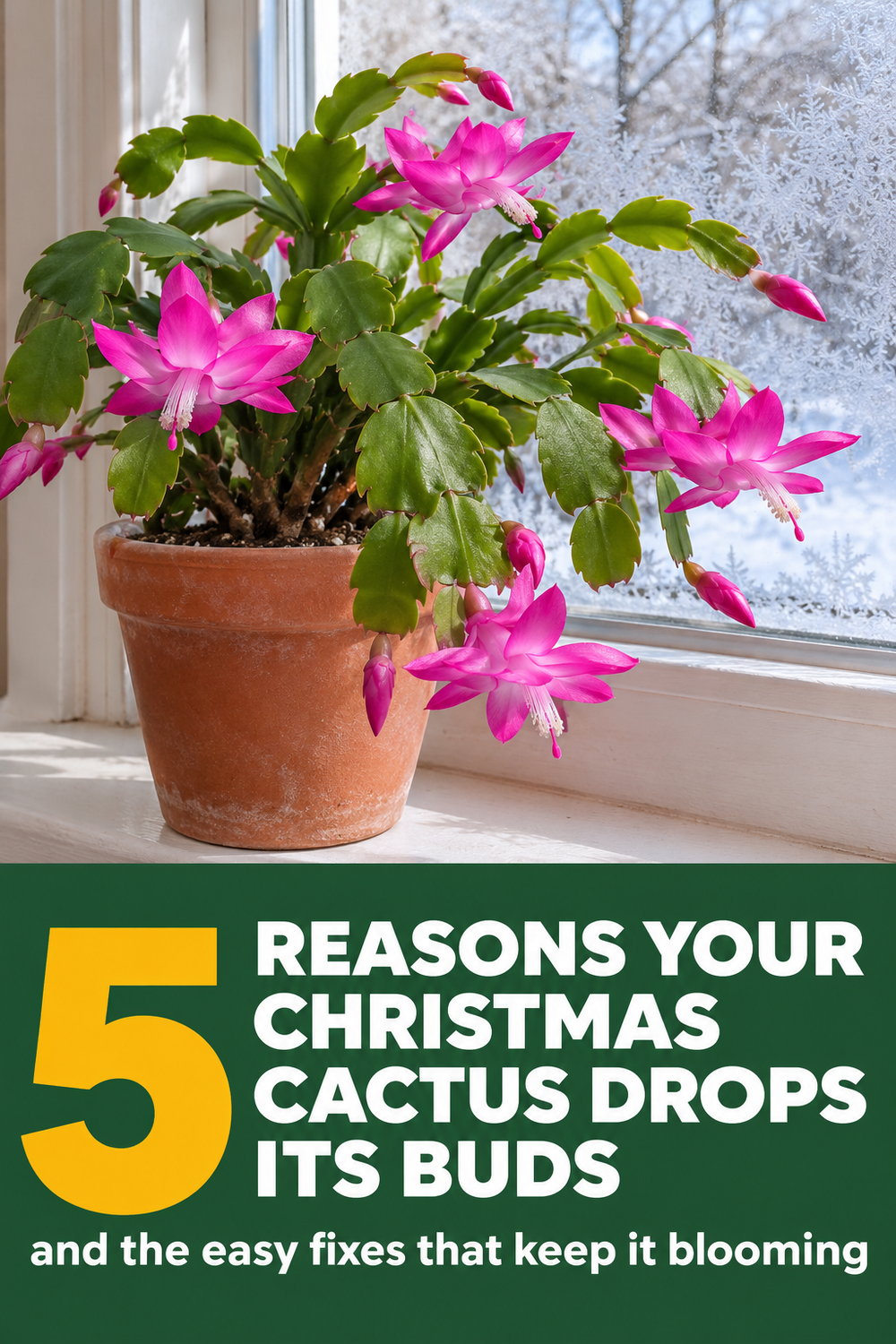
Christmas cactus care is mostly about keeping things steady: the buds drop when the plant is moved, chilled, overheated, dried out or soaked. Here are the five causes, the fix for each, and the simple routine that keeps a Schlumbergera blooming year after year.
Quick answer
Quick answer: Keep your Christmas cactus in bright, indirect light at about 60-68°F, away from heat vents, doors and drafts. Water when the top inch of soil is dry, never let it sit in water, and don’t move it once buds form. For new buds in fall, give it 12+ hours of uninterrupted darkness and cool nights for about 6 weeks.
Is it a Christmas cactus or a Thanksgiving cactus?
Most “Christmas cacti” sold in stores are actually Thanksgiving cacti. Look at the stem segments:
| Plant | Stem segments | Usual bloom time |
|---|---|---|
| Christmas cactus (Schlumbergera x buckleyi) | rounded, scalloped edges | December |
| Thanksgiving cactus (Schlumbergera truncata) | pointed, claw-like teeth | late November |
| Easter cactus (Hatiora gaertneri) | rounded, with bristles | spring |
Care is almost the same for the first two, so the tips below work for both.
Why are my Christmas cactus buds falling off?
Bud drop is a stress reaction. Extension specialists at Penn State, Iowa State and the University of Minnesota point to the same five causes.
1. The plant was moved
Buds form facing the light. When you turn or move the pot, the plant has to readjust, and it often drops buds. Pick its holiday spot before the buds appear and leave it there.
2. Temperature swings and drafts
A cold blast from an opening door or warm air from a heat vent is enough. Penn State gives about 68°F by day and 60°F at night as ideal in winter. Below about 50°F or above 70°F, buds may drop or never form.
3. Too warm overall
A spot next to a fireplace, radiator or sunny south window can push the plant above 70°F, which prevents flowering.
4. Soil too dry
Purdue notes that buds drop when the soil dries out completely. While it’s blooming, the plant needs a little more water than usual. Very dry indoor air can add to bud drop; a pebble tray helps.
5. Soil too wet
The opposite problem is worse. Soggy soil leads to root rot, one of the most common causes of death in holiday cacti (University of Minnesota). Always empty the saucer after watering.
Most bud drop comes from 1 and 2, so start there.
How to care for a Christmas cactus all year
| Season | What to do |
|---|---|
| Blooming (Nov-Jan) | Bright indirect light, 60-68°F, water when the top inch is dry, don’t move it |
| After bloom (Feb-Mar) | Let it rest: water a little less, no fertilizer for about 6 weeks |
| Spring-summer | Normal watering, balanced houseplant fertilizer once a month, it can summer outdoors in shade |
| Fall (Sep-Oct) | Set buds: 12+ hours of darkness each night and cooler nights for about 6 weeks |
What you need
- A pot with a drainage hole, one size bigger than the root ball
- Fast-draining potting mix (regular mix with some perlite or orchid bark)
- A spot with bright, indirect light, away from heat vents
How to water a Christmas cactus
- Check the soil with your finger.
- When the top inch is dry, water slowly until it runs out of the drainage hole.
- Empty the saucer after 10 minutes.
- In a warm, dry room this is often once a week; in a cool room, every 10-14 days.
How do you get a Christmas cactus to bloom again?
These are short-day plants. They set buds when nights are long and cool. In late September or October:
- Give it 12-14 hours of total darkness every night. A spare room or a closet works; even a lamp at night can delay buds.
- Keep nights cooler, around 55-60°F, if you can.
- Water a little less until you see buds, then water normally.
After about 6 weeks, small buds appear at the stem tips. That’s the moment to stop moving the plant.
Common Christmas cactus mistakes
- Watering on a fixed schedule instead of checking the soil.
- Putting it next to the TV or a lamp that stays on late into the evening.
- Repotting while it’s blooming. Repot in spring, only every 2-3 years; it likes being a little root-bound.
- Treating it like a desert cactus. It is a forest cactus from Brazil and wants more water and less sun.
Is Christmas cactus safe for pets?
Yes. The ASPCA lists Christmas cactus as non-toxic to cats and dogs. Eating a lot of it can still upset a pet’s stomach.
Frequently Asked Questions
How long do Christmas cactus flowers last?
Each flower lasts several days, and a healthy plant opens new buds for several weeks.
Should I mist my Christmas cactus?
It likes moderate humidity. A pebble tray or a grouping with other plants helps more than misting.
Why does my Christmas cactus have limp, wrinkled stems?
Usually root rot from overwatering, or a plant that is far too dry. Check the roots: brown and mushy means rot.
Can I cut a piece off and grow a new plant?
Yes. Twist off a piece with 2-3 segments, let it dry for a day, and set it upright in moist potting mix.
In Short
- Bud drop = stress: moving, drafts, heat, dry soil or soggy soil.
- Bright indirect light, 60-68°F, water when the top inch is dry.
- Long, dark, cool nights in fall bring the next flowers.
You might also like: Christmas flowers · Winter garden hacks
Sources: Purdue Extension, Holiday Cactus FAQs; Penn State Extension, Holiday Cacti Care; University of Minnesota Extension, Holiday cacti; Iowa State Extension, All About Holiday Cacti; ASPCA toxic and non-toxic plants list.