
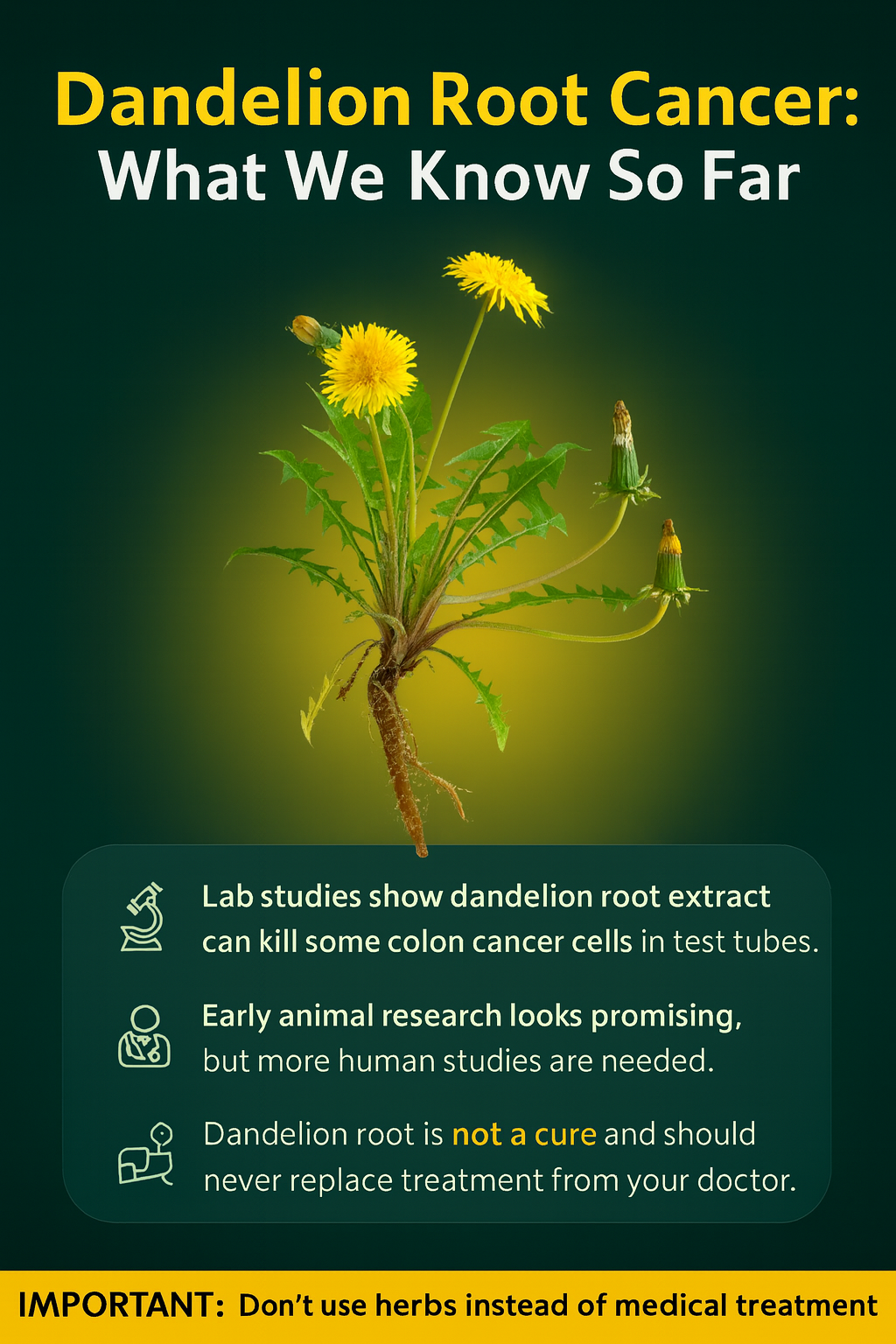
You may have seen an eye-catching claim online:
“Laboratory studies have shown that dandelion root extract can destroy over 90% of colon cancer cells within 48 hours, while leaving healthy cells unharmed. The extract activates several cell-death pathways, even in cancers lacking the tumor-suppressor gene p53. In animal studies, it slows tumor growth without causing toxicity.”
That sounds incredibly hopeful – almost like a miracle cure. In this article, we’ll unpack where this claim comes from, what the research actually found, and what it does and does not mean for people living in the United States, United Kingdom, or Canada.
(Quick note: This is general information, not medical advice. Anyone dealing with cancer should talk directly with their healthcare team about treatments or supplements.)
Where the Claim Comes From
The Canadian research behind the headlines
The long statement about dandelion root extract largely traces back to research carried out in Canada, particularly a 2016 paper published in the journal Oncotarget by Ovadje, Pandey, and colleagues. In that study, scientists tested an aqueous dandelion root extract (DRE) on human colon cancer cell lines in the lab.
They found that:
- DRE triggered programmed cell death (apoptosis) in over 95% of colon cancer cells within 48 hours,
- The effect occurred in different colon cancer cell lines, regardless of whether the key tumor-suppressor gene p53 was present or not, and
- Normal, non-cancerous colon mucosal cells were largely unaffected at the same doses. PMC
This is the scientific origin of the viral statement that “laboratory studies have shown that dandelion root extract can destroy over 90% of colon cancer cells within 48 hours, while leaving healthy cells unharmed. The extract activates several cell-death pathways, even in cancers lacking the tumor-suppressor gene p53. In animal studies, it slows tumor growth without causing toxicity.”
Animal studies: slowing tumor growth
The same research group also tested dandelion root extract in mouse models of colon cancer. Mice were implanted with human colon cancer cells (xenografts) and then given DRE by mouth.
Results showed that:
- Tumor growth was slowed dramatically – by more than 90% in some experiments,
- The mice did not show obvious weight loss or major organ damage, suggesting the extract was well tolerated at the doses used. PMC+1
This is where the line about “in animal studies, it slows tumor growth without causing toxicity” comes from.
How Dandelion Root Extract Appears to Work (So Far)
The same core idea shows up in different forms: Laboratory studies have shown that dandelion root extract can destroy over 90% of colon cancer cells within 48 hours, while leaving healthy cells unharmed. The extract activates several cell-death pathways, even in cancers lacking the tumor-suppressor gene p53. In animal studies, it slows tumor growth without causing toxicity.
But what does “activates several cell-death pathways” actually mean?
Triggering programmed cell death (apoptosis)
Cancer cells often ignore normal signals that tell damaged cells to die. Dandelion root extract seems to push colon cancer cells back toward that self-destruct mode:
- It activates molecules involved in extrinsic (death-receptor) pathways and mitochondrial (intrinsic) pathways of apoptosis.
- It increases markers like Annexin V and propidium iodide staining, which are used in labs to confirm cell death. PMC+1
In simple terms: DRE hits cancer cells from more than one angle, nudging them toward shutting down and breaking apart.
Working even when p53 is missing
The tumor-suppressor gene p53 is sometimes called the “guardian of the genome” because it helps prevent damaged cells from becoming cancerous. Many colon cancers have mutated or missing p53, which makes them harder to treat.
The Canadian studies showed that dandelion root extract could still induce cell death in colon cancer cells that lacked functional p53, which is one reason researchers find it so interesting. PMC+1
Influencing inflammation and signalling
More recent lab research has suggested that dandelion root extracts and related compounds may also:
- Block inflammatory signalling through pathways like TLR4 / NF-κB,
- Reduce the expression of inflammatory genes such as TNF-α, IL-4 and IL-6, and
- Reverse certain changes that promote colorectal cancer cell growth and colony formation. Spandidos Publications
These findings fit with the idea that “the extract activates several cell-death pathways” by hitting multiple biological targets at once.
Why These Results Do Not Prove a Human Cancer Cure
It’s absolutely fair to say that laboratory studies have shown that dandelion root extract can destroy over 90% of colon cancer cells within 48 hours and slow tumor growth in animals, while being kind to normal cells – under very controlled conditions.
But there’s a huge gap between that and “this will cure colon cancer in people.”
From petri dish to patient is a long journey
Here’s what’s important to remember:
- Cell studies (in vitro)
- Done in dishes or flasks.
- Cancer cells are bathed in a carefully measured concentration of extract.
- Researchers can use doses much higher than what a human could safely get in their blood or colon.
- Animal studies (in vivo)
- Done in mice, whose metabolism, immune system, and gut are different from humans’.
- Animals are often genetically similar and kept in very controlled environments.
- Human studies (clinical trials)
- Need to answer: What dose is safe? Does it interact with other drugs? Does it actually improve survival or quality of life compared to standard treatments?
So far, dandelion root extract has only limited early-stage human data, and that’s mostly in blood cancers, not colon cancer. Phase I trials in Canada have looked at DRE for certain refractory leukemias to explore safety and dosing, not to prove it cures cancer. ScienceDirect+1
Supplements are not the same as the research extract
Another complication:
- The dandelion root extract used in lab studies is usually a standardized, carefully prepared aqueous extract with known concentration.
- Commercial dandelion teas, capsules, or tinctures may vary hugely in strength and purity, and aren’t tested in the same way.
So even if the lab extract shows impressive results, that doesn’t mean drinking store-bought dandelion tea or taking random pills will reproduce those effects in a person with colon cancer.
The risk of delaying proven treatment
The biggest danger is that impressive lab data can lead some people to postpone or reject proven treatments like surgery, chemotherapy, radiation, immunotherapy, or targeted drugs.
Cancer organizations in the US, UK, and Canada consistently stress that complementary therapies should never replace standard medical care, especially for serious conditions like colon cancer.
Practical Tips for Patients, Families, and Curious Readers
Even if you’re just curious (or working on a school project), it’s good to know how to think about claims like this.
1. Treat bold claims with healthy skepticism
When you see a statement like:
“Laboratory studies have shown that dandelion root extract can destroy over 90% of colon cancer cells within 48 hours…”
Ask yourself:
- Where is the original study? (In this case, a peer-reviewed journal like Oncotarget.) PMC+1
- Is the article talking about cell studies, animal studies, or human trials?
- Does it mention side effects, dosage, and how it fits with existing treatments?
If the piece only gives dramatic percentages but no context, it’s probably oversimplifying.
2. Always loop in the medical team
If you or someone you care about has colon cancer and is considering dandelion root extract as a supplement:
- Talk to the oncologist or cancer nurse first. Herbal products can sometimes interact with chemotherapy or other medicines.
- Bring the actual label or product details to appointments so clinicians can look up potential interactions.
- Be honest about all supplements, teas, or “natural remedies” being used – doctors aren’t there to judge; they’re there to keep treatments safe.
3. Focus on proven ways to reduce colon cancer risk
Dandelion root extract is still in the “interesting research” category. Meanwhile, there are things with solid evidence behind them:
- Screening:
- Regular stool tests and colonoscopy (starting around age 45–50 for average-risk adults, sometimes earlier if you have strong family history) can catch polyps and early cancers, which are much easier to treat. Canadian Cancer Society+1
- Healthy lifestyle:
- Move more, sit less. Regular physical activity lowers colorectal cancer risk. Canadian Cancer Society+1
- Eat more fiber from whole grains, fruits, and vegetables; limit red and processed meats and ultra-processed foods. Cancer.org+2Bowel Cancer UK+2
- Maintain a healthy weight, don’t smoke, and limit alcohol – all linked to lower bowel/colon cancer risk. Cancer Research UK+2UK Health Security Agency Blog+2
These steps won’t guarantee you never get cancer, but large studies show they can significantly lower the odds and improve survival for people who’ve already been treated. bmj.com+1
4. See herbal medicine as “complementary,” not “instead of”
If, after speaking with a healthcare professional, someone chooses to use a standardized dandelion root preparation:
- It should be viewed as a possible complementary therapy,
- Used alongside, not instead of, evidence-based treatments,
- And monitored for side effects (such as allergies, digestive upset, or interactions if they have liver or kidney issues).
Conclusion: Promising, But Far From a Standalone Treatment
To sum up:
- The dramatic claim that “Laboratory studies have shown that dandelion root extract can destroy over 90% of colon cancer cells within 48 hours, while leaving healthy cells unharmed. The extract activates several cell-death pathways, even in cancers lacking the tumor-suppressor gene p53. In animal studies, it slows tumor growth without causing toxicity.” is loosely accurate in the context of cell and animal studies.
- Those studies do show that a carefully prepared dandelion root extract can selectively kill colon cancer cells in the lab and slow tumor growth in mice, while sparing normal cells and causing little detectable toxicity. PMC+1
- However, we do not yet have strong human clinical evidence that DRE can treat colon cancer in real patients, improve survival, or safely replace conventional therapies. Human trials so far have been small and focused mainly on blood cancers. ScienceDirect+1
Dandelion root extract is a fascinating example of how natural plants can inspire potential new therapies, and researchers in Canada and elsewhere are continuing to explore it. But for now, it should be seen as an experimental, complementary idea, not a cure.