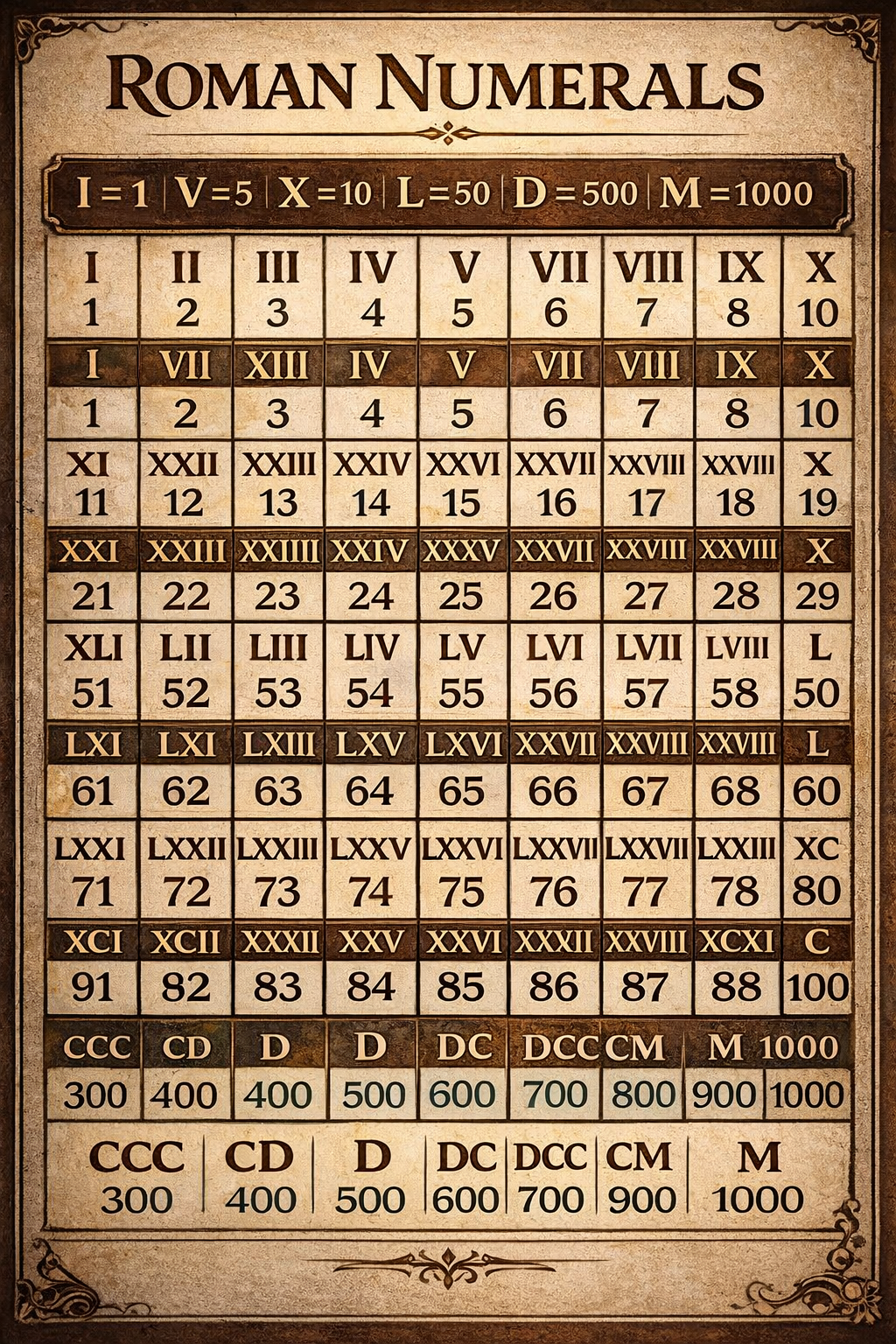
Roman numerals are a numeric system that originated in ancient Rome and are still widely used today in the United States, United Kingdom, Canada, and around the world. You’ll often see them on clocks, book chapters, movie sequels, royal titles, and historic monuments.This quick and practical Roman Numerals Reference Guide will help you understand how they work and how to read and write them correctly.🔢 Basic Roman NumeralsHere are the seven core symbols:Roman Numeral ValueI 1V 5X 10L 50C 100D 500M 1000All Roman numerals are built using combinations of these seven letters.🧠 How Roman Numerals WorkRoman numerals follow two main principles:1️⃣ Addition RuleWhen a smaller or equal numeral follows a larger one, you add.Examples:VI = 5 + 1 = 6XV = 10 + 5 = 15LX = 50 + 10 = 602️⃣ Subtraction RuleWhen a smaller numeral appears before a larger one, you subtract.Examples:IV = 5 − 1 = 4IX = 10 − 1 = 9XL = 50 − 10 = 40CM = 1000 − 100 = 900Only specific combinations are valid for subtraction:I before V or XX before L or CC before D or M📊 Roman Numerals 1–20 Quick ChartNumber Roman Numeral1 I2 II3 III4 IV5 V6 VI7 VII8 VIII9 IX10 X11 XI12 XII13 XIII14 XIV15 XV16 XVI17 XVII18 XVIII19 XIX20 XX🔢 Larger Roman NumeralsHere are some commonly referenced larger numbers:30 = XXX40 = XL50 = L90 = XC100 = C400 = CD500 = D900 = CM1000 = MExample:2026 = MMXXVI(1000 + 1000 + 10 + 10 + 5 + 1)👑 Where You’ll See Roman Numerals TodayRoman numerals are still commonly used in:Clock facesBook chapters and outlinesMovie sequels (e.g., Rocky II)Royal names (King Charles III)Major events (Super Bowl LVIII)Historic building cornerstonesThey add a classic and formal touch to modern design.⚠️ Important Rules to Remember✔ A symbol cannot be repeated more than three times in a row (III = 3, but not IIII for 4).✔ V, L, and D are never repeated.✔ Always write from largest to smallest unless using subtraction format.📝 Practice ExamplesTry converting these:44 = ? → XLIV99 = ? → XCIX500 + 50 + 5 = ? → DLV1000 + 900 + 90 + 9 = ? → MCMXCIX📌 Quick Conversion TipTo convert Roman numerals:Scan left to right.If a smaller number comes before a larger one, subtract.Otherwise, add.With practice, reading Roman numerals becomes quick and intuitive.📜 Final ThoughtsRoman numerals have stood the test of time for over two thousand years. Whether you’re reading a historic inscription, labeling a chapter, or decoding a movie sequel, understanding Roman numerals adds both knowledge and appreciation for this ancient numbering system.