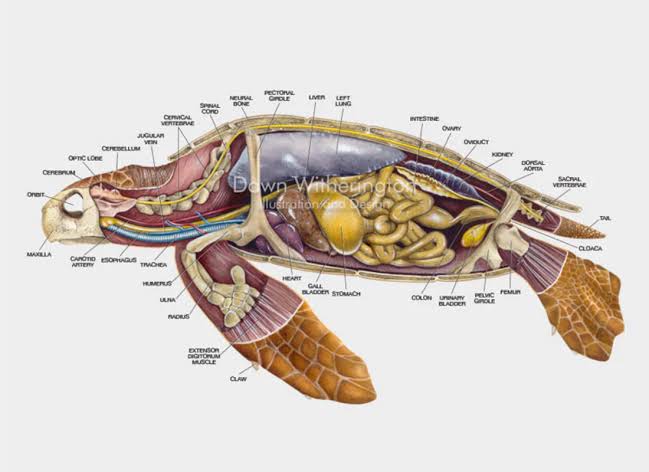
Turtles are among the most fascinating creatures on Earth. With their slow, deliberate movements and seemingly unchanging appearance, many might assume they are simple animals. Yet, the anatomy of a turtle is full of surprises, revealing incredible adaptations that have allowed these reptiles to survive for over 200 million years. From their unique shells to their specialized organs and skeletal structure, turtles showcase a blend of evolutionary ingenuity and resilience.In this article, we’ll explore the anatomy of turtles in detail, uncover surprising features, and explain how their bodies make them true survivors in both aquatic and terrestrial environments.The Turtle Shell: Nature’s ArmorH2: The Carapace and PlastronThe most distinctive feature of turtles is their shell, a complex structure that serves as both protection and support. The shell has two main parts:Carapace: The top, dome-shaped part that shields the turtle from predators.Plastron: The flat underside, which protects the turtle’s belly.Interestingly, the shell is not an external armor but part of the turtle’s skeleton. The ribs and spine are fused to the carapace, giving the shell a rigid and durable structure. This fusion is unique among vertebrates and explains why turtles cannot leave their shells—it’s literally part of their skeleton.H3: Shell CompositionThe shell is made of keratin (the same material as human fingernails) covering bone underneath.Scutes, the keratin plates, vary in size and pattern depending on the species.Shells can grow throughout the turtle’s life, providing lifelong protection.The Skeletal System Beyond the ShellTurtles’ bones are highly specialized to support their unique shape and lifestyle.Limbs: Aquatic turtles have webbed feet or flippers for swimming, while terrestrial turtles have sturdy, column-like legs for walking on land.Spine and ribs: Unlike most vertebrates, the turtle’s spine is fused to the carapace. This unusual skeletal adaptation allows them to retract their head and limbs partially into the shell for defense.Neck vertebrae: Some species can retract their necks straight back into the shell (hidden-neck turtles), while others bend sideways (side-neck turtles).These skeletal adaptations allow turtles to thrive in diverse environments, from deep oceans to arid deserts.Muscles and LocomotionDespite their slow appearance, turtles have highly efficient muscle systems:Swimming muscles: Aquatic species have powerful limb muscles for propulsion through water.Walking muscles: Land-dwelling turtles have strong, clawed feet to dig and traverse uneven terrain.Neck and jaw muscles: These are surprisingly strong, allowing turtles to snap at prey or vegetation quickly.The combination of strong muscles and lightweight shells in aquatic turtles helps them move gracefully underwater, while terrestrial turtles rely on muscle endurance to navigate long distances.Turtle Internal AnatomyH2: Digestive SystemTurtles have digestive systems adapted to their diets:Herbivorous turtles: Long intestines to break down plant matter.Carnivorous turtles: Shorter intestines for digesting protein.Omnivorous turtles: A versatile digestive system to process both plants and meat.Some turtles, like sea turtles, can absorb salt through specialized glands near their eyes, helping them survive in salty ocean environments.H2: Respiratory SystemUnlike most reptiles, turtles cannot expand their ribs to breathe. Instead:Muscular control: They use specialized muscles to move their internal organs and lungs.Air sacs: Aid in efficient oxygen exchange, especially in diving species.Long breath-holding ability: Some turtles can hold their breath for several hours underwater.H2: Circulatory and Excretory SystemsTurtles have a three-chambered heart, like most reptiles, which allows efficient oxygen circulation.Kidneys and bladder regulate water and salt balance, particularly important for species that live in both freshwater and saltwater environments.Sensory Organs and BrainTurtles are surprisingly perceptive:Eyes: Excellent underwater vision; some species can see in color and detect ultraviolet light.Ears: Internal ears sense vibrations; they don’t have external ear flaps.Olfactory system: Highly developed for detecting food and mates.Brain: Small but efficient, allowing complex behaviors like navigation, migration, and problem-solving.Practical Facts About Turtle AnatomyH3: Shell RegrowthCracks or injuries in the shell can sometimes heal naturally, thanks to the bone and keratin combination.Keeping turtles in clean water or controlled environments helps prevent infections.H3: Lifespan and GrowthMany turtles grow slowly and can live for decades.Giant species, like Galápagos tortoises, can live over 100 years, with shells that grow proportionally over time.H3: Unique AdaptationsSea turtles have flippers instead of feet, streamlined shells, and lungs adapted for diving.Desert tortoises can store water in their bladder and survive long periods without drinking.Softshell turtles have flexible shells for speed and burrowing in sand or mud.Why Turtle Anatomy Is So SurprisingTurtles seem simple at first glance, but their anatomy is a masterpiece of evolutionary adaptation:Their fused skeletons allow unmatched protection.Highly specialized muscles and lungs make them efficient swimmers or walkers.Sensory organs are adapted for survival in diverse habitats.Their longevity and slow metabolism make them some of the most resilient reptiles on the planet.Even paleontologists marvel at how little turtles have changed over millions of years—a testament to the efficiency of their anatomy.ConclusionThe anatomy of turtles is a remarkable blend of protection, efficiency, and adaptability. From their fused shells and specialized skeletal structure to their lungs, muscles, and sensory organs, turtles are living examples of evolutionary ingenuity.Whether in freshwater ponds, the open ocean, or dry deserts, turtles have thrived for millions of years thanks to their unique bodies. Understanding their anatomy not only highlights their resilience but also reminds us how intricate and surprising nature can be.Next time you spot a turtle slowly making its way across a path or gliding gracefully through water, take a closer look—you’ll be amazed at the engineering marvel inside that hard shell. 🐢